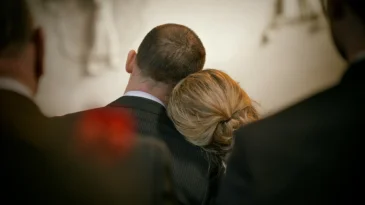


It's been almost 11 years since Paul Swedlund died; but it seems like only a few hours ago.
Maybe that's because his last words to me make more sense now than then.
Before he fell off a Colorado mountain on 17 August 1994, his 48 years were tempered by surviving the Vietnam War as a riverboat captain, abandoning financial gain as a marketable executive for Mobil when called by Jesus to pastoral ministry, enduring friendship with another Paul and me, and switching from the UCC to PC(USA) at my urging.
Actually, he grew up in our franchise and only left because he didn't feel required to learn Hebrew for urban ministry; and he returned after Kansas City's Northminster Church took my advice and called him, presbytery's gatekeepers aka COM forgave the ecclesiastical detour, and he spent about a decade living happily ever after as a reborn Presbyterian until our Lord's last call.
In 2017 we Protestants mark the 500th anniversary of the Reformation that Martin Luther launched and that John Calvin did so much to advance. It is an auspicious time to reflect on the state of Protestantism as a whole as we near this historic milestone. What does it mean to be "protestant" today? Who or what are we protesting against? Is it part of our ecclesiastical DNA to always be protesting something?
Obviously it was our mother, the Roman Catholic Church, our Reformation forbears so vigorously protested against. And with good reason -- Luther alone came up with 95. One of the chief causes of enduring division was the doctrine of justification. Protestants generally patted themselves on the back for being "grace oriented" while caricaturing the Catholics as "works oriented". I grew up around Southern Baptists in the Deep South where Catholics were not even considered Christian. The Presbyterians I knew seemed to be a bit more gracious as we considered them "almost Christian."
It had been one week since the gavel was laid down at the General Assembly in Birmingham, Ala. My energy level had rebounded--it can be tough work as an "observer." But, I was finding it more difficult to bounce back emotionally and vocationally from GA. After hours of debates in committee, debates on the floor, asking whether or not the minority should become the majority report, trying to figure out LES (the electronic report system) and hearing countless people refer to the decline of the Presbyterian Church (U.S.A.) and threats of leaving, I was left wondering isn't there more to life than this? Is there a place to start over fresh? Is staying in this denomination worth it?
This is what we know:
God's people will continue to meet together, for worship, support and encouragement, inspiration, and mission. They will design this in ways that make sense to each of their culturally stratified situations.
This is what we have learned:
It is really hard to change existing churches! It is not only hard to accomplish but it may not be fair. Consider the pastoral implications of demanding that a generation, who has worshiped meaningfully and successfully with a particular style of music and liturgy, suddenly give all that up because kids don't like it. It isn't fair to anyone.
This, then, is what we can do:
New churches; new faith communities in existing churches; new worship services, new fellowships, new identities and new strategies!
Should we, as evangelicals, separate from the Presbyterian Church (U.S.A.)?
Many of us are now asking this question. We know there is no genuine theological solution to the homosexuality issue. We know that any continued unity would be contrived. So, why can't we just admit the presence of irreconcilable differences in our marriage to the PC(USA) and file for divorce? Such a decision, although unfortunate, seems increasingly desirable for many of us.
But should we pursue this as an option? After all, we know that a divorce would probably be messy. There will be no "gracious separation" as some of us may have hoped - far too much money and power is involved for that to happen. Do we want to have a nasty, public fight?
We may be thinking, "Sure, it will be nasty, but it will be worth it in the long run." But surely this can be our choice only if we are convinced that we are fulfilling the will of God. That's where the confusion creeps in.
Some are saying that schism is repulsive to God. Others are insisting that separation is necessary for us to remain faithful. These conflicting voices bewilder us. What we need is a theology of unity and disunity that would help us understand whether separation might be in the will of God or not. To spark thinking in this direction, let's first look at some of the most relevant Scriptures about unity and disunity, as well as two classic formulations from church history. Then let's draw out some of the implications for the present situation in the PC(USA).

John 17:20-26: I ask not only on behalf of these, but also on behalf of those who will believe in me through their word, that they may all be one. As you, Father, are in me and I am in you, may they also be in us, so that the world may believe that you have sent me. The glory that you have given me I have given them, so that they may be one, as we are one, I in them and you in me, that they may become completely one, so that the world may know that you have sent me and have loved them even as you have loved me. Father, I desire that those also, whom you have given me, may be with me where I am, to see my glory, which you have given me because you loved me before the foundation of the world. Righteous Father, the world does not know you, but I know you; and these know that you have sent me. I made your name known to them, and I will make it known, so that the love with which you have loved me may be in them, and I in them.
I think this text is an important touchstone for all of us in the Presbyterian Church (U.S.A.) at this particular moment in our history. It is a time in which many of us are down on our knees praying for the peace, unity, and purity of our denomination -- a time when it is imperiled, when talk of schism is in the air. I find myself sticking very close to John 17 during these troubled days, for I need the reassurance it provides that the Lord Jesus is praying for us too -- and whenever I turn to it, I find it a powerful experience to overhear him speak our names before God in fervent prayer for our unity.

Matthew 13: 24-30; 36-43
Jesus was surrounded by religious/political circles whose membership required strict conformity. The Zealots were gaining strength and their agenda was set in concrete. The Qumran community insisted on the rigid obedience of all members and the Pharisees demanded strict observance of the Law (as interpreted by their own leaders).
Clearly, Jesus did not accept such attitudes. Matthew's Gospel asserts that there was opposition to Jesus' message and in chapter 11:12 Jesus says, From the days of John the Baptist until now the kingdom of heaven has suffered violence, and men of violence take it by force. In such a world, how can the Kingdom of God, envisioned by Jesus, function when violence is inflicted on it? Must fire be met with fire? Many must have thought that there was no place for a tax collector or Zealot in Jesus' fellowship. Matthew 13 appears in such a context.
On June 20, after four years of work by the Theological Task Force on Peace, Unity, and Purity of the Church, nine months of church-wide discussion of its report, and many hours of testimony and debate in the 217th General Assembly, the Assembly approved recommendations from the task force that were intended to dampen if not end the party strife that has roiled the Presbyterian Church for decades. Fifty-seven percent of commissioners voted in the affirmative, making the task force recommendations church policy. Then, within a few hours, both a coalition of conservative "renewal" groups and More Light Presbyterians announced their displeasure with the Assembly's action and promised to promote proposals to the 218th General Assembly (2008) that would remove one or another feature of the "balanced package" the TTF said it was presenting.
Did the task force succeed or fail?
Many of you have heard me preach that I am "sinfully proud of being a Presbyterian." After each General Assembly I ask myself "Are you still?" And the answer is always yes--even after attending 27 straight.
I never agree with all the decisions made, but I still come away Presbyterian. I've always been proud of our historic heritage in forming the United States. I know the break-aways always try to claim this "as well" but they can't quite pull it off.
And all of you who have heard me know there is one thing I consider the most important of all -- mission, mission, mission.
These are times of high-velocity intense change in our denomination. John Detterick and the many now-departed members of our national staff have been a blessing to our church in this time of change. The General Assembly has just ended a challenging meeting. Linda Valentine, the new executive director of the General Assembly Council, along with the rest of the national staff and the GAC, have much to contend with.
All of us are eager for a new and transformational chapter in the life of the Presbyterian Church (U.S.A.). The church is doing many things that matter. The thing that matters most to a great many of us is the design of transformational, missional, and innovative congregations who worship God while passionately engaging their communities to make disciples and to meet human need -- which is in some contrast to our present reality.
At times like these the words of conservative icon Harry Hassall come back to mind. I first heard them after the Wichita General Assembly (1994) voted overwhelmingly to declare, in its response to the Re-Imagining God controversy, that "Theology Matters." We were headed out to dinner to celebrate the joy we felt over the vote. Harry suppressed his glee for a moment to express words that cooled our shared giddiness. He said:
"I have come to realize that, in Presbyterian Church politics, when things look really, really good, they're not as good as you had hoped, and when things look really, really bad, they're not as bad as you feared."
Many folks attending this year's General Assembly at Birmingham spoke in apocalyptic terms about "the end of Presbyterianism as we know it."
Other folks popped corks in celebration of "the end of injustice as we know it."
Well, the apocalyptic end of times was followed by a sunrise; the reports of the falling sky had grown out of inaccurate meteorological reports of last night's sunset.
That blinding sunrise stunned hung-over revelers into the reality that yesterday's injustices had not been eradicated in a single stroke.
On the day after adjournment of the 217th General Assembly, I began a weekend of preaching at the Smyrna Campmeeting in Conyers, Georgia. Families have gathered at this place since 1827 for a week of morning and evening worship services. In those 179 years, the only time campmeeting was not held was the year a gentleman named Sherman was touring the neighborhood. The first campers came in wagons and lived in tents. Those with children brought a cow to supply milk, and the only air conditioning was provided by breezes and shade trees. Worship was held outdoors until an open air, tin-roofed tabernacle was built about 100 years ago. Sermons often went more than an hour.
I'd like to be totally candid and just lay open my heart about where I think we are as a denomination in the wake of the 217th General Assembly. Though I have been called a leader of "moderate evangelicals" in the Presbyterian Church (U.S.A.), I also speak as a 30-year old whose passion for Christ makes all church politics seem a distasteful waste of time, as immersed in it as I am.
In the wake of the General Assembly's recent decision to localize the determination of essential requirements for ordination, I have been receiving lots of advice. Many conservatives feel pressed with the question of whether or not we should be staying in or leaving the PC(USA). This inner turmoil results from the fact that after debating for more than thirty years about whether to ordain persons who are sexually active outside of marriage, the recent Assembly's action was the first time our denomination's policies have actually changed. By passing a new authoritative interpretation of our church's Constitution, it would appear that we have given local governing bodies the license to ordain and install individuals who live in open violation of the church's standards.
"Where do we draw a line in the sand?" I heard that question more than once as we approached the June General Assembly in Birmingham, from pastors and elders wondering what would be the outcome of the "Peace, Unity, and Purity" report with its provision for the right of presbyteries and sessions to allow "scruples" with regard to specific constitutional standards for ordination to our three ordered offices. Many are wondering if they could or should remain in a denomination that will not honor uniformly the provision of G.0106b regarding the expected sexual behavior of ministers, elders, and deacons. I confess that the question has crossed my mind as well, and thus this brief reflection on the subject.
Since the General Assembly approved the Peace, Unity, and Purity Task Force report, some of the press have been reporting that it has approved the ordination of non-celibate homosexual persons at the discretion of local ordaining bodies. The press have it wrong, and in fact the Authoritative Interpretation approved by the General Assembly has probably made it less likely that such ordinations will be allowed.
Editor's Note: While serving as a member of the Theological Task Force on Peace, Unity and Purity of the Church (TTFPUP), I avoided commenting on it in the pages of The Outlook. Now that its report has been adopted by the 217th General Assembly and now that the Task Force has been dismissed from its work, I weigh in.
Three votes. Three stunning votes. A fourth stunning vote, too.
After months of relentlessly intensifying drumbeats pounding the threat of an impending split about to befall the PC(USA), 91% of this GA's commissioners voted to stay together.
A concise summary of this analysis is still available for purchase, formatted on 1/2 sheet to share with your congregation. Click here for more details.
 What does it mean to be a connectional church in the 21st century? Well, we have met the metaphor and the metaphor is us, er uh, we. Actually it goes under the name of Les.
Les is the handy-dandy, internet-intranet computer system utilized at the 217th General Assembly in Birmingham. Les was developed for all the right reasons: a chance to provide constantly current communications to commissioners, delegates and observers--and to save a few thousand trees' worth of paper. Who wouldn't like that?
Well, as you can infer, most everybody could dislike it. Not only did it function on-and-off; it slowed to a crawl at times; people could not figure out how to find the right folders; the system crashed; and a bunch of other technical aggravations arose. It also provided just the entertainment (how many versions of solitaire do you know?) to occupy minds with off-the-subject diversions. What a great way to enhance our communications!
The good news is that its name isn't Hal.
The 217th General Assembly, meeting in Birmingham, has approved an authoritative interpretation of Book of Order paragraph G-6.0108. Predictably -- and unfortunately -- the authoritative interpretation's implications for the issue of ordaining "self-affirming, practicing homosexual persons" has been the sole focus of attention by its supporters and opponents alike. Lost in the narrow debate is recognition that the process for examining candidates for ordination to ministry of the Word and sacrament is woefully inadequate in many, if not most, of the church's presbyteries. Beyond the question of examining gay and lesbian persons for ordination is the pervasive problem of the way we examine any candidate.
The reading: Matthew 25:31-40
Truly I say to you, as you did it to one of the least of these my brothers and sisters, you did it to me (Matt. 25:40).
The question that Dietrich Bonhoeffer asked himself, his students, and his readers remains as urgent now as when he first raised it: Who is Jesus Christ for us today?
Bonhoeffer by no means intended to challenge the authoritative biblical answer. What he confessed with the prophets and the apostles, he attested at the cost of his life. He affirmed that Jesus Christ is the Risen Lord who had become incarnate for our sakes in order to die for our sins and liberate us from the power of death. That was the answer presupposed in every other possible answer to his question. It was the one answer that contained all others within itself.
The PCUSA website has a statement about the G.A. meeting that reminds me of the guy who shot an arrow at a barn, drew a circle around it, and then said, "Bull's eye!" Where's Vince Lombardi when you need him telling this distracted bunch to keep the main thing the main thing? Here is another symptom of a management culture, tinkering at a great distance from men and women faithfully leading congregations across the country. It is an abomination that so many activists approach our democratic structure as a scaffold for pet projects--with unsuspecting commissioners dependent upon information they are fed.
For example, the discussions about Rec. 5 of the PUP Report never addressed the elephant in the living room. Good leadership casts vision with clear, compelling statements about a preferable future. It does not merely imply the real issue or hint at direction.
Last time in this space a discussion of the need for the rebuilding of community in the Presbyterian Church (U.S.A.) — at every level of corporate existence — was begun. As pointed out, the fabric of our community has been severely frayed by a combination of external and internal developments. If we are to be faithful to God’s call in the future, we must self-consciously begin to pray in earnest that the Holy Spirit will reconnect the sinews of our body, and we must take steps to support that work.
What purposes might we anticipate from the GA forming an authoritative interpretation making such giving obligatory? Baltimore Presbytery's overture 23 would fund the larger church's service without causing undue hardship to the presbyteries in the process. They are expected to send 100% of all per capita assessments for all their member churches, and, says the overture, that obligation should be met by the churches themselves. What else might we anticipate from such a ruling? Well, just the opposite is likely to happen.
The question of ordination once again looms large on the horizon. For those of us who are Christian educators, our passionate focus rests on two overtures (12-01 and 12-02) that advocate for a fourth ordained office within the Presbyterian Church (U. S. A.) In this article I will (a) give historical and present reasons for a fourth ordained office; (b) summarize the similarities and differences between the two proposals.

Grey fog hangs heavy,
hovers,
like a decision that eludes grasp.
Rays of our burning star break through,
dispersing fog,
yet, like a direction that flits finality,
reveals but familiar banalities.
Around said star,
earth orbits and rotates,
and still we speak of sunrise and sunsets ...
routines in which, unchanged, we ever move.
Kairos, not chronos,
something new,
to scatter shibboleths.
So,
we wait,
uncomfortably together,
in a room too small,
trying to contain the damage,
until descends a Time,
a gift unmanaged ...
Peace, unity, purity.
Michael Nelms is pastor of The Yellow Frame Church in Fredon, N.J.
There has been quite a bit of discussion about what the Authoritative Interpretation of the 217th General Assembly (PUP as amended) really means for the Church. Soon our stated clerk, whose job it is to "preserve and defend the Constitution" of the church will issue an advisory opinion about what the Assembly did. His advisory opinion is important, because it will likely give sessions and presbyteries their first official word about whether, in his opinion, sexually active gays and lesbians may be ordained or installed. For now, the Office of the General Assembly has set up a page of FAQs where it asks the question, "Will gays and lesbians now be ordained," but it does not answer the question.
© Copyright 2026 The Presbyterian Outlook. All Rights Reserved. Privacy Statement. Website by Web Publisher PRO