

Any discussion of forgiveness must surely open with the fifth petition of the Lord's Prayer which reads,
Forgive us our debts as we also have forgiven our debtors. (NRSV)
This prayer was crafted within the piety of first century Judaism and its famous eighteen prayers (Amidah) most of which are thought to have been in use at the time of Jesus.
One of those prayers (No. 6) is called "For forgiveness" and reads,
Forgive us, O our Father, for we have sinned; pardon us, O our King, for we have transgressed; for thou dost pardon and forgive. Blessed are thou, O Lord, who art gracious, and dost abundantly forgive.

(Used by permission of the author.)
When I knelt to wash the feet of an African-American woman who is an elder of the Presbyterian Church (U.S.A.), I knew the moral universe of my youth had vanished. A cynic viewing the action only moments before when she knelt to wash my feet could argue that nothing had changed. But when the roles changed, even a cynic could acknowledge that deep change has occurred.
It certainly did to me in last Maundy Thursday, when a small group of Christians gathered to remember the gospel story of the night Jesus washed his disciples' feet. We listened to the story and I said a few words about servant leadership. Then we came forward, two by two, to wash one another's feet, reenacting Jesus' humble example of love.
Jesus' parable of the laborers in the vineyard is one of those stories that sounds increasingly outrageous the longer we think about it. The manager's decision to pay the same full-day's wage whether workers labored a single hour or a full day strikes us as grossly unfair. And Jesus, of course, makes matters worse by stepping in and telling us that this picture of scandalously unfair treatment is in fact what the kingdom of heaven is like.
What are we to make of that? God is unfair? God plays favorites? God violates the norms of justice? What comes leaping out at us from the parable, of course, is that the late hires did not deserve the reward they got. They did not qualify for such compensation. We are quite naturally outraged by this miscarriage of justice, and if this is how God does things, isn't there something just wrong about that?
I asked a non-Presbyterian friend not long ago to read what has become not so fondly known by some as "The PUP Report," and to give me his views as an outsider on what all the stir is about. He said, after a serious reading of the document, and an additional look at the actions of the 2006 Birmingham General Assembly, he was a bit mystified by why anyone would get upset over what our denomination had done. Nothing much seemed to have really changed. The Book of Order is still the same. The actions of the Assembly did not change the paragraph that seems to concern some so much.
There have recently appeared in the electronic version of Presbyterian Outlook a number of "open letters" responding to the New Wineskins Convocation. To date, six different open letters have criticized to some degree or another the finding by the New Wineskins Strategy Team that departure from the PC(USA) is a faithful option for those called by God to do so.
I suppose it should not be surprising that those most invested in the man-made construct known as a denomination, who place so much faith in its polity and bureaucracy, would be opposed to any diminution in the core membership of the group. Thus, four of the open letters were written by executive/general presbyters (one of whom is also one of the newest members of the denomination's Advisory Committee on the Constitution): Messrs Hooker, Wyatt, Evans, and Ms. McRight. Only one serving associate pastor, Ms. Jongewaard, and one elder, Mr. Newkirk have commented. With one exception, all of the letters have been polity-based and there has been no real response in any of the open letters to the Biblical and theological concerns that have led us to the point at which we now find ourselves.
September's theater season in New York featured an odd pair of actors in roles that are both loved and loathed by audiences around the world. Mahmoud Ahmadinejad and George Bush made speeches to the General Assembly of United Nations on the same day (Sept. 19), from diametrically opposing geopolitical viewpoints.
One portrays the other as a bully on the global playground, while the latter denounces the first as a rogue state, belonging to the "axis of evil." Were it not for consequences in the real world, the rhetoric alone would be both alarming and entertaining. But historical grievances outstanding and military maneuvers ongoing at the convergence of their respective zones, together with heightened fears of nuclear weapons proliferation, make these theatrics quite dangerous.
Because I am both an elder in a Presbyterian church and a religion columnist for a daily newspaper, I followed the divestment issue closely. I even wrote a column criticizing the church for its failure to be in constructive dialogue with our Jewish brothers and sisters before the 2004 General Assembly vote.
But the more I work with a rabbi on my current book project, the clearer it is to me why we Presbyterians failed to anticipate Jewish anger at that divestment vote and, thus, why we felt obligated to try a new approach in 2006. I have come to understand that most Christians fail to understand much of anything about our faith's historic relations with Jews -- whether good (of which there is precious little) or bad (of which there is enough to take up gigabytes of chip memory).
This is not easy to discuss.
That point was illustrated to me very clearly a few weeks ago while having dinner with a friend in New York City. I had just returned from the West Bank and was recounting some of experiences of my trip. I did have a vague sense that the couple at the adjacent table, a bit close for my comfort, had become rather quiet. That sense was confirmed when the man next to me, apparently having reached his limit of being able to hold his tongue, plunged into our conversation without so much as a polite apology about the intrusion.
In a recent television interview, former president Jimmy Carter pointed out that "the deprivation of basic human rights among the Palestinians is really horrendous" and that "this is a fact that's known throughout the world ... (and) debated heavily and constantly in Israel," but "it is not debated at all in this country."
Difficult or not, we must be able to address it.
Here are your instructions. Take out two pens, one red and the other blue. Read through this edition of The Outlook, underlining everything you like with the blue pen and everything you don't like with the red. Then compare the blue-marked words with the red-marked, asking yourself, 1) "Why do I like or dislike this?" and 2) "Why do other Christians of sincere conviction like or dislike this?"
Before taking on that assignment, do finish reading this editorial.
Lent 5 ¢ Introduction
In recent years, thanks in part to scholarly research, and also to a new and more open dialogue with our Jewish brothers and sisters in faith, we know much more, and understand much more, about the Pharisees. A far more interesting and complex picture of first century Judaism has emerged as a result. We have learned that the earliest Gospel writers, deeply influenced by the increasing competition and resulting hostility between Judaism and their own infant new religion, tended to paint all Pharisees (and in John's gospel, even all Jews) with the same condemning brush. However there is no denying that, among Jesus' own people, and particularly within the religious power structure of that time, there was a growing, and increasingly threatening hostility to our Lord and his message. This week's meditation illuminates some of the grounds for that hostility.
(Matthew 12:22-23, Mark 3:23-27, Luke 11:14-20)
(RNS) For many years I've wondered about the following scenario: What if an archeologist turned up the bones of Jesus and had some decent proof? And what if they were found in such a way that it was hard to deny the claims?
That would really shake things up in the Christian world. After all, Christian faith is based on the belief that Jesus rose from the dead. The empty tomb is an essential component. As St. Paul says in his First Letter to the Corinthians, If Christ is not risen ... then your faith is in vain.
So, to be honest, the news of a new book, The Jesus Family Tomb, and a related Discovery Channel documentary produced by James Cameron, startled me. There are several such tantalizing elements, including an ossuary (bone box) marked Jesus, son of Joseph found besides others marked with familiar names from the family of Jesus.
In response to Ted Wardlaw's well written review of Barbara Brown Taylor's last book "Leaving Church," in the February 19th Outlook, I..
I think each of us has at least one of what the French call our "betes noires," those little black beasts that drive us mad. One of mine is when I hear modern-day Presbyterians saying that faith is our response to salvation rather than saying that we are saved "by grace through faith." So while I enjoyed parts of Merwyn S. Johnson's, "The Marks of the True Church," Presbyterian Outlook, 3-5-07, I was disappointed to hear him repeat this overused--and in my view highly inaccurate--contemporary Presbyterian nostrum. He writes: "How can the Reformation marks of the true Church help us at the present time? Several things come to mind. First, the Reformation confessions have a whole different take on grace and salvation. Faith, they say, is the result of our salvation, not the cause of it." (underscore added.) He continues, "The chief end of the Christian life is to glorify and enjoy God forever, not to be saved for its own sake (Mark 8:34f)."
Let's be honest. While the vast majority of Americans presently oppose the Iraq War, most of those same Americans were being well represented when Congress voted its initial authorization for the use of military force against Iraq. Chilling reports of the use of chemical weapons against its own people, a cat-and-mouse game with U.N. weapons of mass destruction inspectors, and reports of exporting post-9-11 terrorism convinced many of us to support the efforts to depose Saddam Hussein.
Since then, the original intelligence reports have proven erroneous. Most allied nations have withdrawn their troops. The quick overthrow of the government has turned into a protracted civil war. We now find ourselves caught in a military quagmire.
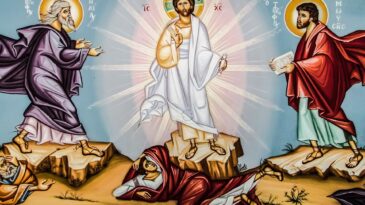
Lent 4 ¢ Introduction
One of the most fascinating and rewarding aspects of being an author is the varied nature of the responses one receives from readers. In recent years I have learned from these that my two earlier Faces... books, Faces at the Manger and Faces at the Cross, were found to be helpful, not only in private, personal devotion life, but also, on occasion, in public worship. Creative pastors, and lay people also, have adapted the musings of the various Faces as dramatic monologues, or even, in one college in Canada, into a whole Christmas Eve service. This week's meditation, in the persons of James and John, might possibly be adapted (into two voices perhaps) for such use on Transfiguration Sunday.
(RNS) If I could wish you a Holy Lent, it would have two components: personal and communal.
At the personal level, it is time to focus on the basics: prayer, study and self-examination.
Prayer, or talking with God, can take many forms, from the formal to the spontaneous, from highly intentional to humble submission. The point isn't to do it right, but to give God the opening.
In his Reminiscences of an Octogenarian (1997), Bruce M. Metzger of Princeton remarks that it has often been said, "The snare of autobiographers is that we see ourselves neither as others see us, nor as God sees us." Dr. Metzger taught many of the New Testament scholars currently at work around the world. But he prepared many more of his students as pastors. I recall how some of us saw and benefited from his ministry in that role
Author's note: Denominational "downsizing" has continued with relentless persistence over the past 30 years due largely to changing views and practices of how Presbyterians ought to fund God's work in the church and the world. Periodic discussions have ensued about the various levels of Presbyterian Church (U.S.A.) governance and their optimum size and shape. The substance of the proposal that follows was first published in the Outlook in 1994. Much has happened in the church and the world since, but recent developments in the denomination have led to requests that the Outlook republish an updated version of the article. Perhaps the time is right for a new "big idea" that has potential to help us all re-imagine how authentically Presbyterian polity could be refashioned to serve the new needs of new times.
On September 26th of last year, I was arrested in the Hart Senate Office building in Washington, D.C., while participating in an intentionally nonviolent, interfaith prayer service to end the war in Iraq. I was not alone; 71 other people of faith and conscience were arrested that day as well, among them four Presbyterian pastors.
Coming out of that experience, a small group of us began dreaming of a new kind of witness for peace. It would be clearly, unapologetically Christian. It would be deeply grounded in worship and in prayer. It would be bold about who Christ calls us to be as peacemakers. It would be an invitation to join a movement of Christians who believe that genuine security will come only when all of God's people commit themselves to build right relationships with one another around the world.
"I believe we are at another such time in our life together when the focused and timely work ... could help us seek a more excellent way, a way guided by the Spirit of Christ seeking mutual understanding and enabling us to speak the truth in love," - the Rev. Syngman Rhee, Moderator of the 212th General Assembly
How can a Presbyterian congregation embrace "emergence" while remaining true to its historical roots? The members of Mountain View Church in Loveland, Colo., struggled with this thorny question, as have many other Presbyterian Church (U.S.A.) congregations. It is answering it in both a creative and unified way.
When they had prayed, the place in which they were gathered together was shaken; and they were filled with the Holy Spirit and spoke the word of God with boldness (Acts 4: 31).
Rick Smyre wrote in a recent edition of Net Results: "All communities and churches will face, without exception, the need to transform themselves as the effectiveness of old ways crumble."* As we try to imagine new capacities for new realities, as we try to help people learn how to think differently, it will also be important to help people see God in new transforming ways. Our capacity to respond to new realities is either hampered or enhanced by the images of God we have inherited.
We gathered for worship at our 9:00 a.m. service on a recent Sunday morning. It was a special time--it would conclude with the baptism of a little baby. I welcomed the large contingent of family and friends who had joined us for worship, expressing to them my hope that the Scripture and sermon would speak to them on this special occasion. I would read from 1 Samuel 1, a tender passage about Hannah dedicating her son, Samuel, to the Lord.
However, instead of turning to chapter one of I Samuel, I unknowingly turned to chapter two. I began reading what I thought would be words of encouragement to the congregation and the family of the child to be baptized:
On February 9, I welcomed the New Wineskins gathering at First Presbyterian Church of Orlando on behalf of Central Florida Presbytery. As I read and thought about the gathering in advance of the day, I remembered that there have been many ways to be a Presbyterian in this country down through the generations. In the past three generations of my own family, there have been Presbyterian ministers in 5 denominations. Grandfather served as a missionary in India for the UPNA for 40 years. My father served in three denominations, the 'old' USA church, the UPC and the PCUS. I have served in the PCUS and the PC(USA). For us, the differences were matters of geography and history not controversy. Still, I was reminded that there have been lots of ways to be Presbyterian; lots of divisions, and, thanks be to God, several reunions.
One of my treasures is a small volume titled, The Book of Church Order 1925, Revised Edition. This book is six inches high, three and one-half inches wide, and one-half inch thick, with big print and lots of white space. Our current Book of Order measures nine inches high, six inches wide, and is one inch thick, with much smaller print. Recognizing that the Book of Order had gotten somewhat cumbersome, the last two General Assemblies set into motion processes for shortening our current book and making it more user-friendly. The idea is to remove some of the material that is currently in the book and put that material in manuals to be used by groups such as committees on ministry, committees on preparation for ministry, and so forth.
We have always known that the seminaries related to the Presbyterian Church (U.S.A.) are centers of theological depth for the preparation of a new generation of ministers and church leaders. We are discovering much more than that these days.
© Copyright 2026 The Presbyterian Outlook. All Rights Reserved. Privacy Statement. Website by Web Publisher PRO