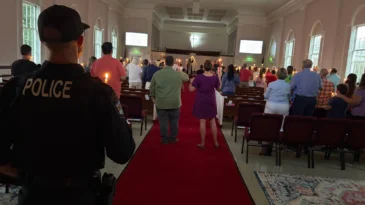


When Norman Blessing retired and moved to Florida about four years ago, he joined First church in Sebastian because it was the closest Presbyterian church around. He had no intention of launching what one observer has characterized, in a letter posted on the Internet, as "the last great battle" of the Presbyterian Church (U.S.A.).
The faith of the church is not something we formulate but which, instead, has been given to us through Godís self-disclosure in Jesus Christ, the Holy Scriptures and the confessions of the church ó ancient and modern ó and the preaching of the church. Faith, most fundamentally, is the childlike trust in the goodness and faithfulness of God, but equally important it is our understanding about who God is, who we are and Godís intention for the redemption of fallen humanity in the good creation.
A Statement of Conscience
Respectfully submitted to the Presbytery of Yellowstone
By the Session of 1st Presbyterian Church
Anaconda, Montana
March 4, 2002
We, the Session of 1st Presbyterian Church of Anaconda, Montana, after careful study and prayerful reflection, respectfully inform the Presbytery of Yellowstone that we cannot in good conscience comply with any interpretation of Book of Order provision G-6.0106b that restricts the rights of governing bodies to discern the will of Christ in choosing leaders. Therefore, we declare:
In democratic America every person is supposed to be equal to every other person. However, in spite of this quondam theory, a lot of people regard themselves as superior not equal. They prefer to be leaders rather than followers. This is a perfectly understandable desire because on a sled run, only the lead dog gets to look at the scenery. All the other dogs are looking at something else. In fact, what the other dogs see and what they do can both be described as a "running behind."
One of the great images of the Old Testament is the prophet Isaiah’s peaceable kingdom, of the holy mountain where all the beasts that tear at each other and destroy one another in real life find perfect harmony through the will and power of God.
As we enter the Lenten season, it is appropriate that we consider the biblical vision of peace — shalom — which is God’s goal for the good creation.
The church is constituted — i.e., is brought into being — by its participation in the reality of what God has done in Jesus Christ. This reality is embodied and proclaimed in the narrative of God for us, Christ with us and the Spirit among us. It is this reality — this dynamic story of God’s engagement to be our God — to which the Scriptures, as the Word of God written, bear witness.
The National Board of More Light Presbyterians recognizes with regret that Amendment A has been defeated. We are profoundly grateful for the 29 presbyteries and overture advocates, the Ordination Standards committee and the 212th General Assembly that sent Amendment A by a margin of 60 percent to all of our presbyteries for discernment and consideration.
With the vote of South Louisiana Presbytery on Feb. 19, the Presbyterian Church (U.S.A.) has obtained the simple majority needed for the defeat of Amendment A, maintaining the "fidelity/chastity" provisions regarding ordination standards in the Book of Order. Should the current voting patterns continue in the presbyteries remaining to vote, where the pro-gay proposal is being rejected by a two-to-one margin, the defeat will signal the strongest affirmation to date on the part of the vast majority of Presbyterians in preserving the biblical witness to marriage between a man and a woman, and in upholding those standards for ordained leadership. This is an encouraging sign of renewal.
With unofficial results showing that a majority of presbyteries have
rejected proposed Amendment 01-A, the Covenant Network of Presbyterians
released the following statement:
With the Presbyterian Church (U.S.A.) seeking a way forward in these times of theological and political conflict, some have suggested a "third way," and now The Presbyterian Outlook has urged a "third force." Presbyterians for Renewal believes what is really needed is a recommitment to the Third Person of the Trinity.
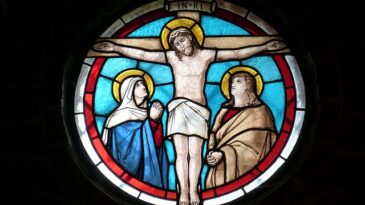
Formerly a United Methodist minister, I am now Presbyterian. Methodists don't use the line, "He descended into Hell" as part of the Apostles' Creed. It was always hidden in the footnotes, a part of the traditional creed, something no longer used. In the Presbyterian Church (U.S.A.), people affirm their faith as a community, in response to hearing the Word of God.
Over the last 10 years, we have seen an increasing incidence of candidates for the ministry and ministers transferring from one presbytery to another using functional language such as "Creator, Sustainer and Redeemer" to refer to the Trinity. This avoids using the personal language of "Father, Son and Holy Spirit."
As the writer of all but two words of the "Affirmation of the Lordship of Christ" that was adopted by the 213th General Assembly (2001), I want to thank the Office of Theology and Worship for their statement, "Hope in the Lord Jesus Christ." The statement is longer and more fully developed than the short affirmation by the Assembly, but the two declarations are in complete harmony.
Everything That Rises Must Converge is the name of a book of collected stories by distinguished 20th-century Southern writer Flannery O’Connor. Her vision of the kingdom of God is embedded in her stories. One in particular, "Revelation," ends with a vision of humanity in all of its magnificent diversity marching upwards into the heavens to greet the loving God who awaits with open arms.
All Christians are called upon to confess the Lordship of Jesus Christ. As Presbyterians we make this confession guided by what our church has stood for through the ages. For Presbyterian Church leaders in particular, this guidance is embodied in the literature collected in our Book of Confessions. As ordained leaders we vow to
sincerely receive and adopt the essential tenets of the Reformed faith as expressed in the confessions of our church as authentic and reliable expositions of what Scripture leads us to believe and do.
All of us who are or have been pastors know what it is like to be in the middle of a marital or family counseling session and realize that what the parties are arguing about isn’t really the issue. They may be talking (or yelling) about a child’s grades, but the problem for the family lies elsewhere. The grades are merely what they’ve decided to argue about.
Jesus said, "I am the way, the truth and the life. No one comes to the Father but by me." Some Presbyterians argue that we must take these words to mean that since Jesus is the only way to salvation, Christianity is the only true religion. Therefore any genuinely two-way conversation between Christians and followers of other religious traditions inevitably compromise true Christian faith and leads to religious and ethical relativism.
This month representatives of more than 1,000 of the more than 11,000 congregations of the Presbyterian Church (U.S.A.) are gathering in Atlanta to bear witness to their faith in Jesus Christ, the authority of Scripture and God’s call to holy living.
Like the Task Force for the Peace, Unity and Purity of the Church authorized by the 213th General Assembly, this group seeks to follow the guidance of the Holy Spirit in response to the events unfolding in the life of the Presbyterian Church (U.S.A.).
In his recent article, George Hunsinger offers thoughtful reflections on the present impasse in the Presbyterian Church. His proposed "third way" is..
Professor Migliore’s proposed interpretation of G-6.0106b, while not impossible, is by no means necessary. If we stick to the direct wording of the text, and do not read things into it which are not there, then a different interpretation is more to the point. G-6.0106b simply states what is true by definition. There are either those who are married (one man and one woman), of whom fidelity is required, or else those who are unmarried (single), of whom chastity is required, as it is of all Christians.
If we are to move beyond the theological impasse tearing at our church today, it may be wise to revisit the lessons American Presbyterians have learned over the decades concerning the confessional nature of the church.
That there is a dispute about Presbyterian confessional identity today is nothing new. Such disagreement goes all the way back to the colonial experience. From the early 1700s there were two ways of thinking of Presbyterian confessional identity.
Since a majority of subscribers to The Presbyterian Outlook are not graduates of Davidson College, I am providing the proposals that will come before its Board of Trustees meeting that began Feb 3rd. These proposals were presented for a ‘first reading’ at an October board meeting and have been in the hands of college alumni/ae since early December.
Into the midst of a denomination which finds itself hopelessly locked in a cyclical conflict that seemingly admits of no solution except for the destruction of one side or the other by its mirror opposite comes a Theological Task Force for the Peace, Unity and Purity of the Church, authorized by the 213th General Assembly (2001).
Now is the time for a third force to emerge in the Presbyterian Church (U.S.A.). The phrase "third force" rather than "third way" is offered, because the third way, if it exists at all, is not yet in sight. A genuine third way through the political thicket in which we are caught will be biblically and confessionally rooted, and will represent the consensus of the faithful that God’s will for our time has been discerned and must be affirmed.
Writing recently in The Outlook, Editor Robert Bullock recognized that annual meetings of the PC(USA) General Assembly seem to be hurting the church and bringing unnecessary division. He wrote: "Annual meetings allow divisive issues to be brought up every year with the potential for win-lose votes at the meeting and in the presbyteries . . . . Dealing with divisive issues year after year through an annual meeting of the General Assembly has not been a plus for the Presbyterian Church (U.S.A.).If an institution’s national gathering does more harm than good to the institution, shouldn’t the institution consider seriously having the meeting less often?"
© Copyright 2026 The Presbyterian Outlook. All Rights Reserved. Privacy Statement. Website by Web Publisher PRO