
The Birth of Jesus
There is power - and then, there is power. There is the power that comes with military supremacy and another kind of..


There is power - and then, there is power. There is the power that comes with military supremacy and another kind of..

Getting to Bethlehem this year has been rough. Immediately after last year's trek came the massive Indian Ocean tsunami. Since then we have endured the most active hurricane season ever on record, including the still mind-numbing devastation wrought by Hurricane Katrina. October brought the earthquake in Pakistan that killed a staggering 75,000 people. Meanwhile, fresh accounts of political corruption continue to fill newspapers, heating bills are up, and national morale is down.
How do we get to Bethlehem this year? A minimum wage worker must work almost a full day to fill his car's gas tank. Airlines are struggling in bankruptcy. Amtrak is plagued by equipment breakdowns. How do we get to Bethlehem? How do we get past the 150,000 service men and women who are in Iraq, separated from family and festivities, and for some, separated from new babies they have fathered but never seen? Amid suicide bombers and improvised explosive devices, their safety is anything but assured; their length of stay is up in the air.
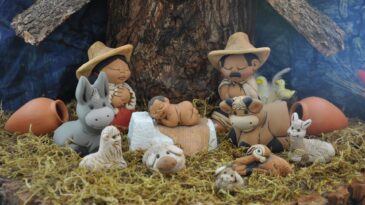
The National Cathedral in Washington, D.C. has a crèche collection gathered from all over the world. Various hands sculpted these figures from every conceivable material: stone, wool, glass, and even cow dung. The tropical regions portray Jesus under palm trees with very little cloth swaddling him, while cold climates show the holy family wrapped tightly, huddled and surrounded by snow. They remind us that we interpret this beautiful story in our own contexts; we pick up what the gospel writers leave out as we imagine the earthy smell of the hay, the rough texture of the feeding trough and the gentle sounds of the animals. These miniature mangers capture that crucial period after a baby is born, when the bonds of relationships strengthen as an infant is introduced to a family with care and attention. It is a time for welcoming, healing and wholeness.
In our culture, family leave policies enable this opportunity, yet within our church, that time off is often seen as an unnecessary benefit. Although sick leave after major surgery is expected, congregations can be unclear about the fair expectations of parents when a child enters their family. When I look at the adoring Mary and Joseph, a startling love bubbles up as I recall the birth of my own child. I also remember the confusion in our churches and Presbytery.
Login to see an overview of movies playing this 2005 holiday season.
by Bruce Feiler. New York: William Morrow, 2005. ISBN 0-06-057487-9. Hb., 416 pp., $26.95.
For many of us the settings of the stories of Scripture never leave the black and white page; or they are confined to the imagination of our minds re-creating biblical scenes, or recalling the interpretation of countless Christmas pageants, Sunday School dramas, and Vacation Bible School reenactments. The sand of the desert never sifts into our shoes, because we've never been there. Even for those who have journeyed to the Middle East, the sites of many stories remain unidentified by imprecise texts, undetected due to the shifting sands of time, or inaccessible due to modern conflicts. In Where God Was Born Bruce Feiler chronicles his travels to Israel, Iraq, and Iran to seek out some of those places, and to explore the way faith was shaped there among Jews, Christians and Muslims.
The Theological Task Force on Peace, Unity and Purity revived our interest in Presbyterian history in the United States since 1729, but stopped short of formative roots in the old world. Recently my wife and I joined a presbytery- sponsored tour to visit some sources of our Reformed faith in Scotland and Ireland. We found significant historic challenges to the peace, unity and purity of the church, and also surprising foundations for hope.
"Purity" was a driving force in the turbulent events of the Scottish Reformation. Purity was the match used by John Knox and his colleagues to ignite the flames of church (and national) reform in Scotland--purity in the Word of God, in the sacrament, in the clergy, and in the leaders of the land. In his passion for religious purity, Knox sparked an emotional explosion among Scottish people early in St. Andrews in 1547, and again in Perth, Edinburgh, and beyond beginning in 1559. In these violent birth-years of the Presbyterian Church, purity-minded mobs attacked the churches and monastic houses to strip them bare of their images of "idolatry," typically burning the churches to the ground, and often inflicting bodily harm or death to Catholics who resisted.
Museums and monuments to formative religious struggle marked our Presbyterian heritage across the lowlands and up into the Scottish hills, written in blood by passionate Presbyterians in the never-to-be-forgotten massacres like Glencoe and Culloden.
Newsflash!
Aoccdrnig to a rscheearch at an Elingsh uinervtisy, it deosn't mttaer in waht oredr the ltteers in a wrod are, the olny iprmoetnt tihng is taht frist and lsat ltteer is at the rghit pclae. The rset can be a toatl mses and you can sitll raed it wouthit porbelm. Tihs is bcuseae we do not raed ervey lteter by itslef but the wrod as a wlohe. i
Isn't it amazing what powers of perception humans have? Even when mortal expressions are limited and imperfect, humans have been gifted with the ability to discern much more meaning from a written text than a surface review might reveal.
Think how often a word or two -- spoken or written -- is misconstrued because we fail to open our minds to the whole of what is intended by the one desiring to communicate with us.
Being one, I like to defend ministers whenever and wherever possible. Our "too too solid flesh" is subject to considerable frailty, but in a Presbyterian pulpit there is little excuse for blatant and pompous stupidity. Listening to a Christmas sermon our family learned a painful lesson in the hermeneutics of suspicion. The text was "Comfort ye, comfort ye my people, says your God" (Isaiah 40:1).
In the October 3, 2005 issue of The Presbyterian Outlook, the question "How Do We Change the Book of Order?" was answered by reviewing steps and deadlines that must be followed to change our constitution.
Blood everywhere!
So recently The DaVinci Code argues in exciting and so Mel Gibson's "The Passion of the Christ" demonstrates in excruciating detail. In the hot flash of a mini-pause the issue of blood becomes a fascinating subject. The Israelites regarded blood with holy awe because they understood blood to be the life of the flesh. Under the old covenant, the offering of blood was central to the sacrificial system.
ORLANDO -- The Presbyterian Coalition, not content to wait, started months before a major task force report was due out to prepare its own statement of where it thinks the Presbyterian Church (U.S.A.) ought to be going -- a paper that is not shy of proclaiming theological truth.
The paper -- "Given and Sent in One Love: The True Church of Jesus Christ" -- concludes in an afterward that the church should reject the report of the Theological Task Force on the Peace, Unity and Purity of the Presbyterian Church (U.S.A.). Two pastors wrote "Given and Sent in One Love" -- Gerrit S. Dawson of Baton Rouge, La. and Mark R. Patterson of Ventura, Calif. -- and it was published as a book with help from the Presbyterian Lay Committee, Dawson said.
The Coalition released the paper, based on the prayer that Jesus prays in the 17th chapter of John, on Nov. 7 at the start of its national gathering at First Church in Orlando.
ORLANDO -- How much do many evangelicals dislike the report of the Theological Task Force on the Peace, Unity and Purity of the Presbyterian Church (U.S.A.)?
Listen to some of what's been said at the national gathering of the Presbyterian Coalition, held Nov. 7-9 at First Church in Orlando.
Jim Berkley, interim director of Presbyterian Action for Faith and Freedom, the Presbyterian arm of the Institute on Religion and Democracy, called the task force report "an indigestible sausage" that "would permit behavior that would have scandalized Jesus himself."
Michael Walker, executive director of Presbyterians for Renewal, has praised some sections of the task force report. But he described the task force's fifth recommendation as 'damaging to the church,' and said it could with one General Assembly vote 'effectively do an end run around three decades of discernment by the whole church.'
John "Mike" Loudon, an evangelical pastor from Lakeland, Fla., who's one of the 20 task force members, was invited to answer questions about the report. But Berkley, not Loudon, got to describe and analyze what the task force had done -- and the first question Loudon was asked was about what tradeoffs the task force had made to achieve a unanimous vote.
Loudon was gracious, saying he sees the report as a way for the PC(USA) to stay together, keeping its national ordination standards but allowing them to be applied locally. "Nowhere does it say to remove those national standards," Loudon said. "In fact, I fought long and hard to maintain those national standards."
ORLANDO -- The preachers talked a lot about trust in a sovereign God, even in difficult times, even when surrounded by "slippery theology," as pastor David Swanson put it. Don't lose hope. Don't give up. Don't lose sight of the truth.
But the political discussions at the Presbyterian Coalition's national meeting Nov. 7-9 were mostly about how to keep bad things from happening at next summer's General Assembly -- and what to do if something terrible does happen, such as (from the Coalition's point of view) the assembly approving the report of the Theological Task Force on the Peace, Unity and Purity of the Presbyterian Church (U.S.A.).
If that does happen, some contended, certain evangelical churches will be ready to leave the PC(USA).
There was also another theme subtly drifting through the conversations at the Coalition meeting, held at First Church in Orlando. Don't just look at what's wrong with the other side, evangelicals were told -- take a look at yourselves too.
Andrew Purves, professor of pastoral theology at Pittsburgh Theological Seminary, preached during closing worship about the need for both truth and love -- saying that a church with "shining orthodoxy" but without love "is no longer the church."
Swanson, senior pastor of First Presbyterian in Orlando, did not stint on criticism of the PC(USA)'s misguided directions during his opening sermon, citing examples such as a declining number of missionaries, a Washington office that supports political causes, sessions or presbyteries that ordain lesbians and gays.
Journeys of Courage: Remarkable Stories of the Healing Power of Community, by Joy Carol. Notre Dame: Sorin Books, 2004. ISBN 1-893732-79-7. Pb., 256 pp. $14.95.
If you have ever put the newspaper down after reading an account of some recent horror, and said aloud or to yourself, "How will these people carry on after this? What will they do with all the anger and pain from this atrocity?" then here is a book for you.
If you ever despair for this sin-saturated world and wonder if, in fact, evil does not often have the last word, then here is a book for you.
Or, more practically speaking, you face the weekly task of mounting the steps to the pulpit and you need some fresh material to illustrate your sermon, then here is book for you.
Joy Carol, spiritual director, author and counselor, gathers story after story from world communities that have endured the traumatic impact of "man's inhumanity to man." These communities "responded to their dilemmas by courageously facing them or changing their reactions to them." Through these "journeys of courage" the communities "underwent some kind of transformation, some kind of healing power."
This is storytelling, pure and simple. Carol does not reach for extended theological reflection; she does not seek to offer biblical connections. In fact, she does not profess that this is a Christian book, per se, though many of the stories come from Christian communities of faith.
Carol gathers these stories because she knows that "telling and hearing stories can be powerful medicine." The stories of moral, spiritual, emotional courage are mined and shared to en-courage others. And they do.

My big brother Chris is 47 years old. His best friend Fritz died of cancer when they were both 43. When our family moved to Minnesota, Chris and Fritz met in school, and they stayed friends through high school, college, and beyond. They played basketball in high school together, and they wrote a sports column for our school newspaper with one other friend each week entitled "The Blonde Bombers." Fritz hung out at our house a lot, and by the time he and Chris were in senior high, my junior high friends and I started to develop crushes on their group of friends; I, of course, developed a crush on Fritz, who was tall, blonde, and blue-eyed. Unfortunately, the crush was never mutual. I was too much like a "little sister."
Though he was over six feet tall, everyone in our small town called Fritz "little Fritz" because his dad was "big Fritz," the large-bellied owner of the German bakery in town. My mom was always glad to see Fritz at our house at night because he would bring some of the day's leftover bakery goods, all of which we readily consumed. Fritz's mom was a dear soul and still spoke like the true German she was.
When Fritz was first diagnosed with cancer a number of years ago, my brother kept us all connected with him through weekly and sometimes daily e-mails. He sent updates of Fritz's treatment, from the first radiation to the last experimental chemotherapy, and then to his worsening physical condition at home. But there was a wonderful side to these e-mails. Chris told of the strong faith in God and deep love for each other Fritz and his wife, Lynn, had; of what I would call Fritz's deep joy in life. It sounds odd, of course, to speak of joy in the midst of the situation. But joy it is what I heard through these e-mails, even joy amid pain, suffering, sadness, and questions.
Deck the halls with expectation. 'Tis the season for anticipation.
The original lyrics better fit the tune, but these words do fit the season. Children dream sugarplum dreams. Soldiers count down the days to a holiday leave. Shoppers look forward to a smiling friend unwrapping that perfect gift. Worshipers sing of the arrival of the Savior.
Why such December expectations, Advent anticipations?
The answer--God places them in the hearts of believers. They prompted landlocked Noah to build a boat, and elderly Sarai to decorate a nursery. They moved Ruth to leave the green fields of Moab and David to sing songs. They spoke to Mary treasured words of shepherds and angels. They emboldened Peter and John to command, "Rise up and walk."
Sadly, in post-Watergate America and in the post-reunion Presbyterian Church (U.S.A.), cynicism--anticipation's dread enemy--seems to be out-shouting the more hopeful voice. Alongside impatience, apathy, certitude, and self-importance, cynicism has been waging war on the more hopeful Christian virtues of faith and trust. Of course, sinning ways of sinful people continually pump more helium into the balloons of disappointment in the church, but the resulting pessimism misses the point of Christian faith.
Throughout the biblical record and pervasive through church history the refrain is sung, "Have faith in God!" Bold faith animates the stories told of the first century Christians. Deep trust radiates from the lives of millions of faithful through the centuries, and for good reason. God has come through for them. The one who promised to build a church against which the gates of Hades would not prevail has overcome time and again.
In this season of Advent, in a time when many Presbyterians are warning of the demise of the church, how can we recover the vibrant faith of our forebears? Might we dare believe again that the best is yet to come?
Scripture text: Psalm 89
Finding Psalm 89 among the texts for Advent 4 begs this question: Should Advent be a season of emotional de-crescendo and rest, as the church approaches with certainty the time of God with us; and/or should it be a time of emotional crescendo and dismay as we fly through yet another year of "how long, O Lord" (Psalm 89:46) with no certainty of the Messiah's imminent return?
Appearing elsewhere in the lectionary cycle at the end of Lent, on Maundy Thursday, Psalm 89 speaks to a time of crisis, as hope in the Lord appears betrayed and headed toward certain death. Therefore, the appearance of Psalm 89 again, here, leads me to this conclusion: Although the church tends to advocate emotional de-crescendo as Advent progresses, "but now" (v. 38), the church should be entertaining an emotional crescendo of lament that the Lord has NOT come as promised; that the disconnect between promise and reality is almost unbearable yet again. Only then is the joy of Christmas a true expression of God's in-breaking hope in the midst of seeming impossibility and dismay.
Concluding Book III of the Psalter, Psalm 89 is a royal psalm, swinging the faith of Israel between assertive confidence in God's steadfast love, faithfulness, and promise to all generations (v. 1-4), and at the other extreme, Israel's protest and disappointment in God's apparent breach of covenant in abandoning the anointed one during the exile (v. 38-51).
Editor's note: This is the fourth in a series of stories entitled: "What is a Presbyterian Elder?" (link to 'For Church Officers' articles)
The word "elder" in the Greek New Testament is presbuteros (for the biblical background see Part 1 in the April 25, 2005 issue). And the question is this: How many different kinds of presbyters are there in the PC(USA)?
The answer "one" is correct from an initial perspective. All elders are called by Jesus Christ and are united in one Lord, one faith, and one baptism. They serve one worldwide church. What is more, anyone who is ordained an elder remains so for life unless he or she requests release from office by the session (G-14.0211), joins another denomination, or is temporarily or permanently removed from office for an offense (D-12.0000).
In another sense there are two different kinds because there are elders in every congregation who serve various functions. Elders who are currently on the session are what used to be called "ruling" elders, but all other ordained elders in the congregation are still able to serve the Lord's Supper, and be commissioners, committee members, or officers of higher governing bodies (G-10.0102 p; 14.0203).
Welcoming Jack Haberer
Editorial note: This issue is the inaugural for Jack Haberer's tenure as editor-in-chief of The Presbyterian Outlook. Several Presbyterian leaders, some of whom have worked with Jack in denominational efforts, give their thoughts on his coming to this new ministry:
Pulpit nominating committees need a lot more help than they are getting. For example, when I left my first pastorate, the pulpit nominating committee met and quickly agreed that whatever else, they did not want another minister who wore a beret and made pastoral calls riding a bicycle. They thought these practices were not only eccentric but weird then, in fact, one was thrifty and the other was theological.
Even though she and her husband lived in a single-room studio apartment during their two years in Ethiopia, our daughter-in-law found it necessary, and quite against her inclination, to employ domestic help. Without the laborsaving devices for cooking, cleaning and washing that American women take for granted, Sara had no other option if she wanted to continue to teach at the seminary in Addis Ababa.
On prospective board members my institution desires to make a good impression. This is not easy because the standard campus tour includes classroom time, and I seem to be the only instructor teaching at the hour guests are free to attend a lecture. Over the years these classy people regularly show up at my classy room five minutes before the lecture begins.
Among the obscure items I collect to amaze my students and annoy my colleagues is the by-now-long-useless fact that in 1869 Alexandrine Tinne was hacked to death by the Touaregs. Alexine was an incredibly rich, incredibly beautiful, incredibly brave woman who, at enormous expense, attempted to explore the White Nile and its tributaries.
Obligatory summer visits to our family requires a road trip from Pittsburgh to Nashville to Albuquerque to Denver to Milwaukee. This duty is rendered pleasant by minor league baseball games all across the country. In my secret heart I still believe if I had not gone to the seminary I might have gone to the baseball hall of fame.
Every body, or to be precise – every mind, needs three reading lists. The first will contain the essential books of your field. The second list will offer solid insights into and felicitous expressions of one's individual and community interests. The third is just plain fun to read.
© Copyright 2026 The Presbyterian Outlook. All Rights Reserved. Privacy Statement. Website by Web Publisher PRO