

The initial reactions to the Authoritative Interpretation of G-6.0108 approved by the General Assembly in San Jose were dramatic. Some were rejoicing, others despairing, because they believed that the General Assembly, in approving the overture submitted by the John Knox Presbytery, had removed the impediment to the ordination of non-celibate gays and lesbians that had been declared by the General Assembly Permanent Judicial Commission in the case Bush v. Presbytery of Pittsburgh.
As mainline congregations grapple with the “graying” of their ranks — average age pushing into the mid-60s — many recognize they need to serve “young adults” more effectively.
Welcome to the ’tweener edition of The Presbyterian Outlook. We go to print too early to be able to report any news of the General Assembly (one exception: see p. 6). You receive the magazine about the time the Assembly is adjourning, so any pre-Assembly analysis we might offer is moot. Hence, we find ourselves caught in the middle — in between the times.
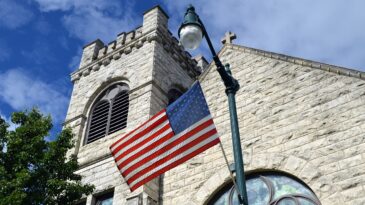
Editor’s Note: This sermon was preached recently at First Church in Dubuque, Iowa. The Scripture references include Psalm 146:1-7, Romans 13:1-7, and John 18:33-38a.
As proud bearer of the nickname, “Honest Habe,” I begged to be given the part of that heroic senatorial candidate, when Mr. Warnaar assigned our fifth grade class to re-enact the Lincoln-Douglas debates. Greg Smith was assigned the role of Stephen A. Douglas, and, sure enough, I drew the name of Abraham Lincoln.
As the mobility rituals of summer begin — one in five families changing homes, education years ending, new jobs starting, church-shopping under way — this is a good time to remember the basics of welcoming visitors:
When the General Assembly commissioners* take up proposals regarding sexual orientation and practice, three questions will hang in the air.
By way of disclosure, I am well into my 74th year, and have been a Presbyterian all of my life, first in the old Northern church, then the United Church in the North, then the old Southern Church, then the Northern Church (in the South), the Southern Church (in the almost North), and finally our present Presbyterian denomination. I have served as a deacon in two of those denominations, and a pastor in three of them. I was raised in a congregation with history that stretched back to the early 1700s, and in my teenage years I was
"Women Blaze an Interfaith Trail: Two teachers become first Jewish female and first Muslim female to receive advanced degrees from Catholic Theological Union," and "She's First Jewish Graduate of Catholic Theological Union" were headlines in The Chicago Tribune and The Chicago Sun-Times on May 15.
On May 15 the California Supreme Court affirmed the rights of same gender couples to the legal protections and responsibilities of marriage. Not coincidentally, in 1948 it was the California Supreme Court that first extended equal protections to interracial couples — a full sixty years ago, twenty years before Loving v. Virginia declared all miscegenation laws unconstitutional. The ruling will go into effect thirty days after the decision.
The members of the General Assembly Council (GAC) have taken great strides to enlarge our world mission work. In the process, they and Presbyterian Foundation together have sought to deploy all available funds for use in mission and ministry.
However, three proposals coming before the San Jose GA this June 21-28 could alter the way those funds get invested and deployed (see p. 8). If the commissioners handle these proposals well, the mission of the church will be advanced. If mishandled, controls built into the system to ensure proper allocation of funds may be compromised.
How are your teeth? The Form of Government (FOG) section of the Book of Order will climb onto the dentist’s chair for commissioners’ diagnosis when the 218th General Assembly gathers in San Jose, Calif., this coming June 21-28.
I can’t wait for GA. I can’t wait for this General Assembly 36% more than I couldn’t wait for the past GAs. That’s because we’ll have 36% more commissioners (see p. 6) who will generate 36% more excitement.
He didn’t include you or me in his will, but his legacy has made us rich, and his vision continues to illumine our eyes years after his death — August 6, 1998 and one hundred years after his birth — May 7, 1908.
They’re off! The race is on. The kickoff is in the air. The puck is on the ice. The first pitch is thrown.
Choose your favorite athletic metaphor. Easter is behind us and the 218th General Assembly looms on the horizon — awaiting us on June 20 in San Jose, Calif. The season of contesting legislation and campaigning leaders has been launched.
So how do you respond to the Jeremiah Wright episode? Most pastors would be thrilled to discover that after one's retirement from pastoral ministry millions of people watch videotaped excerpts of their sermons. Wright probably isn't thrilled.
The broadcast on YouTube of excerpts from some of Wright's sermons has generated widespread
Baseball is often rhapsodized as a religion in America. It makes sense then that Yankee Stadium is a stomping ground for popes.
The only two who have set foot on U.S. soil have celebrated Mass in the Bronx, in the most famous sports arena this side of the Colosseum.
On April 20, Pope Benedict XVI was set to become the third.
The crisp, hot, late afternoon sunshine in Nicaragua is perfect for playing baseball. Who might want to play?
We notice that the construction crews seemed to finish up the day's work with a bit more energy and gusto; several of them asked me as the work for the day wound down, "Baseball?" Just that one word, with their deep Spanish language accent, and the interrogative lilt rolling up at the end, turned a word into a question. "Si," I would readily reply, wondering what I was getting myself into.
One colleague calls it "Amnesty April." Others call it "data cleanup" and "data scrubbing."
Whatever the name, this month at the church I serve we will initiate a thorough cleanup of our membership data. That may seem a small and mechanical matter, but I think it cuts to the heart of what we do.
Recent studies indicate that only about half of our church members grew up Presbyterian, and many of these left our Presbyterian congregations during their teen years only to return later as they begin to establish families. As a result, an understanding of our Presbyterian heritage and the tenets/themes of our Reformed faith is not part of the background or memory of most of our members.
As folks make a commitment to the ministry of teaching children or youth, they often come to the task with a sense of call, a love for young people, a desire to pass along the stories of our faith, and an earnestness to teach with creativity and age appropriateness. However, many are unaware that being Reformed implies particular things about the ways that we teach the children and youth in our care. To that end, we look to the major tenets our tradition to consider how they inform our teaching.
I have seen the dream. Three times. And since it takes two or three witnesses to confirm, I now believe it to be true. The APCE folks are pointing the way to a vital, healthy future for the Presbyterian Church (U.S.A.). The energizing and edifying General Assemblies of the future may well resemble the APCE conferences of today.
This past month, I attended my third-in-a-row conference of the Association of Presbyterian Church Educators, a gathering of 1,000+ leaders from around the PC(USA) -- plus counterparts from the Presbyterian Church in Canada, Christian Reformed Church, and the Reformed Church in America. For the third time in a row the conference I attended overflowed with authentic worship, superior skills enrichment, warm fellowship, and thoughtful ideas engagement (see p. 9).
Power plays and political maneuvering were conspicuously absent.
How can this be? How do they avoid the political wrangling that overwhelms General Assemblies?
Much hand wringing and pessimism -- maybe fatigue? -- is evident as we seek to engage our congregations in vital, faithful, effective Adult Christian Education. Also evident are the attempts to understand how and why things are different. Contributions from those versed in demographics and sociological realities have been useful. People who study leadership and systems theories have provided keen insights into our current situation and challenges. Generational theory has been a powerful lens through which to evaluate our context and relationships. Examining postmodernity and its effects on educational ministry can be helpful as well.
This article offers some of the ideas presented at my workshop, "Brain Research Comes to Sunday School," at the Association of Presbyterian Church Educators conference in February. The good attendance at this workshop is an indication that Christian educators want to learn about brain research and ways it might help them be better teachers. In Our Spiritual Brain, Barbara Bruce wrote that religious educators need to know how the brain functions and how to translate that information into better, more usable lessons to help students continue their journey of faith.
"There you go, God, here is some Play-Doh for you," a four-year-old announced, placing a blob of yellow Play-Doh on the table and then scooting an empty chair next to her own so that both touched. She continued to roll and mash the Play-Doh, every so often adding a bit more to the handful for God until her mom arrived. As she said goodbye to one of the adult leaders, she held up her hands closed tightly together and whispered, "All you have to do is hold your hands like this and God is with you. God likes coming to Sunday school with me and he's holding my hand now to go to church with me." Although resembling the imaginary friend of a young child, God truly existed in the heart and mind of this young child. A few years later in a kindergarten through fifth grade Sunday school group talking with the leader about fears, her connection with God gave her the confidence, despite being one of the youngest in the group, to share with the others, "I know God is always with me even if I can't see him and when I am afraid at night I just talk to God."
Consider the following familiar scenario. A pastor takes a new call in youth ministry. He begins enthusiastically, on fire to gather young people into Christ's fold. Youth ministry begins to flourish over the course of the next two years, and then suddenly he resigns. The youth are devastated. The congregation is at first bemused, then shrugs its collective shoulders, and re-gathers itself for another mission study, another search committee, and hopefully a better match. Perhaps the next associate pastor will last a little longer.
© Copyright 2026 The Presbyterian Outlook. All Rights Reserved. Privacy Statement. Website by Web Publisher PRO