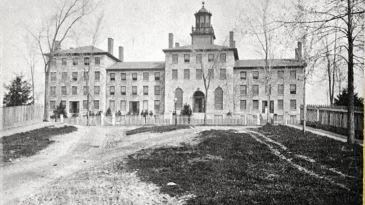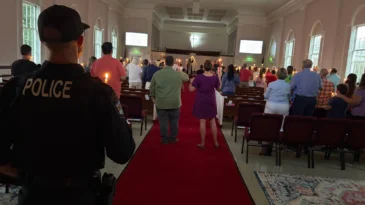


Something was different. It might have been that this service was happening on a Friday night instead of a Sunday morning, but that was not quite it. The church was uncharacteristically packed, but that was not it, either. That about 99 percent of its occupants were women might have been part of what seemed so unusual in that sanctuary. But more than anything what was palpably, noticeably different in this northeastern mainline United Church of Christ cathedral was the sense of anticipation, of expectancy and maybe even downright excitement at what was about to transpire.
So I showed them things.
Not much that was spectacular, in fact,
more the usual, ordinary stuff
like wild flowers, birds and seeds,
The Psalms contain a collection of metaphors for God that focuses on protection. These include: shield, high tower, fortress, high place, refuge, rock, and stronghold. These images use "homeland security" language. But in the Psalms there is also a minority point of view that describes God as "the good shepherd" (Psalm 23), the good woman (Psalm 131:1-2), and the good father (Psalm 68:5-6).
In the "flat" world of Internet-centric communications, churches are a major beneficiary.
Powerful tools once reserved for well-heeled organizations are available at little or no cost to everyone, including churches struggling to control costs. All it takes is the imagination to see possibilities, the humility to try new ways, and the will to overcome resistance from those who distrust technology or fight any change.
Reflecting on this passage in its entirety is beyond the scope of this brief article. Two high points will be our focus. The first is the Christological confession of Martha and the second is the surprising anger of Jesus and its aftermath.
No, not the E.T. or the J.P. that first come to mind. That's E.T. as in Thompson, and J.P. as in Price.
'Tis no small thing to try to fill the shoes of E.T. Thompson. Ernest Trice Thompson and his partner, Aubrey Brown, took over the Presbyterians of the South newspaper and turned it into The Presbyterian Outlook in April 1954. In the years that followed Thompson collected articles, edited them, wrote editorials, and wrote Sunday School lessons -- and did all that every week.
In semi-retirement I turned down an opportunity to serve on the candidates committee, as we used to call it, thinking that if I accepted the assignment I'd feel like I hadn't retired from anything. I'm sure those who do serve the committees on preparation for ministry are much appreciated for the work they do on behalf of new "recruits." Here are some "post-game" reflections for the benefit of those who're soon to become "rookies" and are wondering and wavering about whether or not to enter the field.

The discussion between Jesus and Nicodemus focuses on the Trinity.
After an introduction, in the dialogue between the two of them, Nicodemus makes three speeches to which Jesus gives three replies. Furthermore, Jesus introduces each reply with the phrase, "Amen, Amen I say to you." Whenever this phrase appears something of supreme importance is being said. In the Gospel of John, only in this text do three occurrences of this rare affirmation appear. What is their significance?
Churches should be aggressive in using latest technologies, both to maximize return on investment and to communicate effectively.
An e-mail newsletter is central. The days of the printed and mailed newsletter are over. They cost too much and are read too little, especially among young and middle-aged adults. You can offer a mailed newsletter to those who prefer it, but not many will prefer it. (One large church estimates that a regular postal newsletter costs $2,100 to prepare and send, not counting staff time; an e-mail newsletter costs $15.)
Slowing down, this holy season,
may be the way to go.
Letting go, at least an hour here
and there, of that wheel
with which you drive, and which drives you.
Recently the world of spiritual study and practice has been shocked by a previously unknown revelation about the severe doubts of Mother Teresa of Calcutta. For years she could not find Christ and at times doubted her calling to serve the poor. Some people wonder if they should continue to honor her as a spiritual mentor if she had such trouble finding her way.

Slowing down, this holy season,
may be the way to go.
Letting go, at least an hour here
and there, of that wheel
To hear 800 Presbyterian college students singing out songs of praise is encouraging/discouraging.
To see those 800 wear t-shirts that boldly proclaim their faith -- many unabashedly announcing their affiliation with our denomination -- is really encouraging/discouraging.
To listen as those 800 talk about following Jesus intently, serving God sacrificially, and listening to the Spirit attentively gets downright, overwhelmingly encouraging/discouraging.
Here's a little trivia question for you: What is the one sacramental promise that we make as members of the Presbyterian Church (U.S.A.)?
Answer: At each baptism the church is asked to promise to help guide, raise, and nurture the child (or adult) in the ways of the Church of Jesus Christ.
Working for years in business, I have been fascinated by the way we do "business" as a Church. No other organization would continue to lose more than 40,000 "customers" a year and not make major changes after two or three years. And yet the Presbyterian Church (U.S.A.) loses members at that rate and I find that most Presbyterians don't even notice.
In recent months, schism has become a matter of public debate. It was once an inchoate concern, as evidenced by the first recommendation of the Task Force on Peace, Unity, and Purity that called us to avoid division into separate denominations; it is now the topic of competing published articles.
It is not surprising that there is no resolution to the current debate, for the church was born and nurtured by schism. The early church believed itself a part of Judaism, divorcing itself from Judaism only in the face of persistent rejection by the Jewish community. Western Christianity, already divided from the Orthodox 500 years earlier, was riven by schism from attempts to reform the Roman Church. Though we cherish it, what we Protestants call the Reformation is more accurately described as a protestant schism. And no Protestant tradition has escaped schism, most particularly the Reformed Tradition, probably the most schismatic of them all. We Presbyterians have our own special history of division.
In identifying "Listening Church" as a key factor in determining congregation wellness, we are saying that clergy and lay leaders must make a commitment to listening to the actual questions members are asking.
That commitment, in turn, leads immediately to a second: a commitment to act on members' questions. Not just to hear them, but to respond to them, indeed to be guided by them.
When planning Vacation Bible School activities, Nicole Carmines decided it wasn't enough to require background checks on volunteers and to inspect photo IDs at child pickup time.
So she decided to hire two uniformed police officers to stay on church premises for the entire week. Excessive? Carmines doesn't think so.
"We constantly hear comments about extra measures that we go through," said Carmines, Vacation Bible School director at Concordia Lutheran Church in San Antonio, Texas. She says parents are grateful for the precautions -- which include everything from ID tags to a walkie-talkie network. Seven years ago, 650 elementary school-aged students signed up for Concordia's Vacation Bible School. VBS enrollment this June broke the 1,300 mark, and she believes the staff's diligent security is one of the biggest reasons.
Those of us above a certain age remember well the 80s movie "Dirty Dancing." If above 40 at the time, you had to decide whether to allow your teen-ager to see it. If under 20, it was a "rite of passage" to see a movie with a title designed to provoke your parents' censorship genes.
Many small churches are thriving today because they share ministry, mission, and/or leadership with other small churches. Once a model for the rural church, shared ministry is becoming an effective approach for urban and suburban congregations as well.
In late July, a Consultation on Shared Ministry, sponsored by the Synod of the Northeast, Auburn Theological Seminary, and the Mission at the Eastward, was held in Farmington, Maine.
Many Presbyterian congregations find themselves in changing neighborhoods, with aging members, declining membership and attendance, and with facilities they can no longer manage. Many are closing their doors, or at least wringing their hands looking for that "special pastor" to come in and turn things around, One such congregation found a new life by giving theirs up. This is part of their remarkable story.
I was called to Shiloh Bethany Church in November 2004 to become their half-time pastor for redevelopment and transformation. By that time, Shiloh was a very small congregation, with a membership of around 50 and average attendance around 25. Most of the members were more than 70 years old.
Shiloh Presbyterian Church was founded in 1884, and Bethany Community Church in about 1886 -- they merged in the 1920s.
Whew. They're back, and none too soon. The caucus-goers of Iowa and citizens of New Hampshire got back their late night voting guides just in time to decide who the national parties' candidates should be. After months of missing the daily counsel of Jay Leno, David Letterman, Bill Maher, and Conan O'Brien, not to mention the earlier evening advice of Jon Stewart, Stephen Colbert, and their peers, at least a few of these wise guides found their way back to TV just before those key votes were cast. The world is saved.
With Lent approaching, the time is ideal for providing instruction on the classic spiritual disciplines and to show possible ways and examples from life.
In addition, congregations should offer opportunities to act, such as mission work and prayer vigils.
Doing and learning need to go hand in hand. Otherwise, the doing loses its foundation, or the learning becomes sterile and precious.
The point isn't to promote a single way, but several ways that work together to promote spiritual wellbeing.
2008 Vacation Bible School planning is underway. Publishers of VBS curricula give the following synopses of available material.
Concordia Publishing
Join our Friendship Trek, a hike through the Bible to meet Jesus, our Forever Friend.
Kids find faith, fun, and friends at Friendship Trek! Bullying, inclusion and social skills are hot issues for kids. Friendship Trek kids encounter the incredible love of Jesus, our Forever Friend, and practice friendship skills in a daily Good Friend Challenge.
Kids explore five friend-filled Bible stories about Jesus. They follow Jesus as He reaches out to a new friend named Matthew. They go along as a centurion's friends ask Jesus to heal the man's servant. They traipse to the temple as Jesus heals a blind friend, then go to Bethany to see Jesus raise his friend Lazarus from the dead. Finally, they huddle in a locked room on Easter night to witness the ultimate love Jesus showed by giving His life for His friends.
Jesus is the greatest friend of all!
The stories in the Gospels are best understood as history theologically interpreted. There is history -- something happened. There is theological interpretation -- the Gospel authors were not mere recorders of the tradition but also commentators on the stories they passed on to their readers.
Many different approaches have been taken to the study of the temptations of Jesus. The stories themselves, like other Gospel stories, can be likened to three great diamonds that need to be examined and slowly turned in order to appreciate the beauty of the light reflected from their various facets. Very briefly, we ill look at a few options for interpretation.
Teri Peterson has learned the hard way.
The first year she gave up coffee for Lent, she went straight from the sunrise Easter Sunday service to Starbucks.
The second year, she went to Starbucks before the sunrise service and brought the coffee with her to the worship service on the beach.
At the time, "I lived in downtown Chicago, so I walked past a Starbucks every 50 yards," Peterson said. "I called it my personal wilderness -- it was brutal."
This year, Peterson -- now an associate pastor at Ridgefield-Crystal Lake Church in Illinois, about 50 miles northwest of Chicago -- is still figuring out how she observes Lent. She's not likely to give something up -- she figured out she spent more time those years thinking about coffee than about why she'd given up coffee.
© Copyright 2026 The Presbyterian Outlook. All Rights Reserved. Privacy Statement. Website by Web Publisher PRO