
Advertisement

“Test any word…”

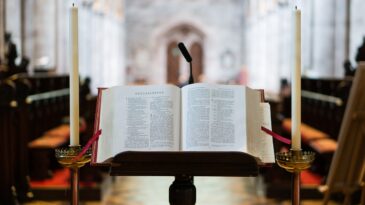
Reformation Day (which this year – perhaps too appropriately – fell on Halloween) provides a needful occasion on which to reflect on the role of Scripture and preaching in the Presbyterian Church.  The matter is made urgent by the recent election that sacrificed (at a cost of 600 million dollars on the presidential race alone) substantive debate about the serious issues before this republic on the altar of entertainment, spin, and downright dirty lies.

Thank Offering

Gratitude, if and when it does arrive,
seems very seldom centered on the meal itself.
Yes, the sacred bird with all its panoply
is blessed in solemn, if embarrassed grace.

Glimpses of Ghana: WARC reflections

Celebrate, Celebrate, Celebrate said the words of the theme song for the 24th General Assembly of the World Alliance of Reformed Churches (WARC) held in Accra, Ghana, July 30-August 13, 2004. It focused on the Scripture assuring life in fullness (John 10:10). The words and the tune reverberated throughout the campuses of University of Ghana, Legon and the Ghana Institute of Management and Public Administration (GIMPA).

Coming or Going

Does there come a time for everyone
when looking forward yields
to looking back; when fond memory
takes over from anticipation
and what has been holds pride of place

Presbyterian churches and the “M” word: Giving with gratitude

It's the sermon pastors hate to preach, the ones congregations hate even more to hear.

 It usually comes in the fall, and it's when they ask, cajole, even plead for  ... money

And, theologically, it's all about God, our relationship with money, and thanksgiving.

"Gratitude is at the heart of our spirituality in the Reformed tradition," Tim Hart-Andersen, pastor of Westminster church in Minneapolis, preached last spring at a Presbyterian Church (U.S.A.) gathering on stewardship. "There is no other human response to God more basic than gratitude, a deep thanksgiving that wells up from within . . . Our churches and those who inhabit them need such a rekindling of biblical stewardship, where we learn again what once we knew so well: `The earth is the Lord's, and the fullness thereof.' " (Psalm 24:1)

GAPJC rules in Heartland Presbytery case

(PNS) The General Assembly Permanent Judicial Commission (GAPJC) of the Presbyterian Church (USA) has ruled that a session's failure to pay its per capita apportionment cannot be the sole factor in the presbytery's determination whether that congregation is eligible for requesting financial assistance from the presbytery.

In it's Oct. 18 decision in Johnston, et. al. v. Heartland Presbytery, the commission also ruled that a congregation's failure to pay its per capita apportionment and mission pledge could not be the determinative factor in a presbytery's refusal to grant assistance to that congregation. At the same time, the GAPJC determined that "a congregation's effort to pay its full per capita apportionment and to fulfill a mission pledge is clearly relevant as one factor among many others that a presbytery may consider in exercising its stewardship responsibility to allocate limited resources in action upon a congregation's request for assistance."

Thanksgiving: Of plenty and plunder

It’s clearly possible that we Americans need to distinguish between what has been given us by the hand of Almighty God, and what we have wrested by exploitation from others who were in this land before we were, as well as from those who were brought to the ‘New World’ against their wills and purchased by us, and as our property made enduring contributions to our national wealth. Thanksgiving is a peculiar American holiday.

At the gate: The injustice of poverty

It was my privilege during August this year to visit both Guatemala and El Salvador. I was in Guatemala in the company of my son Herb, who is a journalist/editor for the Diocese of Michigan. We then joined a group of Episcopal communicators for a week in El Salvador.

Remembering two leaders: In gratitude for Kennether Hall and Shirley Guthrie

The PC(USA) lost two outstanding leaders almost exactly a week apart with the deaths of C. Kenneth Hall on October 15 and Shirley Guthrie on October 23 (see obituaries in the November 8 and today’s issues of OUTLOOK). Both exercised extraordinary spiritual gifts in lives wholly committed to the gospel of Jesus Christ and to ministry in the Presbyterian Church (USA).

Are Presbyterians Thankful Enough?

At this time of year it is worth thinking about our attitude toward God in prayer. So many negative things happen in our own lives, the church, and in the world that are dangerous and disheartening. we often start our prayers by listing our fears about potential disaster. As a denomination we run the risk of constantly focusing on our disagreements, our declining membership, and our lack of power in the world.

Archaeological find includes ancient blessing

It is a prayer heard in almost every synagogue and church
throughout the world:

"May the Lord bless you and keep you; may the Lord
cause his face to shine upon you and be gracious unto you;
may the Lord lift up his countenance upon you and grant you peace."

Two staffers gone in wake of Hezbollah meeting

LOUISVILLE - Two key Presbyterian Church (USA) staff members were apparently fired November 11 by General Assembly Council (GAC) Executive Director John Detterick - with no clear public explanation for their departures.

Kathy Lueckert, the deputy executive associate director of the GAC, the governing body of the church's mission program agency, and the Rev. Peter Sulyok, coordinator of the Advisory Committee on Social Witness Policy (ACSWP), are no longer employed by the GAC.

Leuckert has served the denomination for five years, Sulyok for nearly twelve.

Lueckert supervised Sulyok and both were members of an ACSWP fact-finding delegation to the Middle East last month that included a televised meeting with Hezbollah, an organization that is on the U.S. government's watch list of terrorist groups.

Sexual questions, few answers at Covenant meeting

CHICAGO -- These progressive Presbyterians came to Chicago to talk about theology and sexuality -- about what it means to be a Christian and to live responsibly and faithfully as a sexual being.

And, like the wind whipping famously down Michigan Avenue, fueled by the torrents of the presidential election and the sting of John Kerry's loss, the conversation at the Covenant Network of Presbyterians' annual gathering quickly swirled into other territories too.

How can the church talk convincingly to young people -- many of them with their feet firmly planted in the secular world -- if it rarely talks about sex at all?

What should the church say about sex outside of marriage -- is it always wrong? What about committed, long-term relationships among unmarried partners, including gays and lesbians, but also church-going senior citizens and huge numbers of heterosexuals who live together or certainly sleep together before they marry?

Conference center responsibilities

I planted, wrote Paul to the Corinthians, Apollos watered, but God gave the growth. (I Corinthians 3:6) 

This image of the church is a flourishing plant, a living organism with deep roots, firm foundations, and tender branches. I am concerned about the tender branches, especially as they matriculate each year in church conference centers.

Taskforce explores core tenets as basis for discussions

CHICAGO -- No votes have been taken.

It's kind of like reading the tea leaves before the kettle has even come to a boil.
But a preliminary, tentative, test-the-waters discussion Oct. 13 indicated that the Theological Task Force on the Peace, Unity and Purity of the Presbyterian Church (U.S.A.) still is searching for consensus on some of the most controversial issues it faces, including homosexuality and ordination.

On the first day of its Oct. 13-15 meeting, the task force considered draft papers on two big issues -- what to say to the church about ordaining gays and lesbians who are sexually active, and whether the denomination ought to spell out what it considers to be essential tenets. Neither of those papers was being formally advanced as reflecting the task force's position nor was up for a vote.

But at its last meeting, in August, the planning team for this October meeting suggested that it might be time to put forth some "affirmations," some suggested statements about ordination standards and essential tenets, just to see how task force members would respond -- basically, to sense where there might be some areas of agreement and where there's still work to be done. Those affirmations were drafted by a working group from the task force consisting of three pastors -- John "Mike" Loudon of Florida, Sarah Sanderson-Doughty and John Wilkinson, both from New York state -- and William Stacy Johnson, who teaches systematic theology at Princeton Theological Seminary.

Taskforce: Facing divisions, strong convictions

CHICAGO -- Immediately after a discussion on global context, a conversation about how the preoccupations and work of Presbyterians in the United States fit into the larger concerns of the world, the members of the Theological Task Force on the Peace, Unity and Purity of the Presbyterian Church (U.S.A.) went into another closed-door session.

They shut the doors on October 15 because they wanted privacy to try to figure out what to say to the PC(USA), particularly on the controversial question of ordaining sexually-active lesbians and gays.

They went from the big view, the international context, to the small: the infighting within the denomination.

Presumably, the conversation had to do in part with theology and in part with politics and power. These 20 people have theological views, convictions, but also in some cases alignments with those in the church involved in the political fight. They are weighing what they want to say in their hearts, what they can afford to say publicly, what the church can accept and what they feel would be prophetic to say. They have developed a deep affection for one another, but they also may want to convince some of their friends to move.

They want to say something that will have the ring of truth.

They want the Holy Spirit to speak.

They want to know how they will know if that has happened.

“The Village” revisited

Ron Salfin in his film review of “The Village” (Sept.6) observes quite rightly that it is a parable, the moral of which is for the viewer to decide. Having viewed this provocative film and entered into the parable to allow its truth to speak to me, I am bold to share my own journey to and from “The Village.”

Righteous judgment: What does the congregation hear?

Editor’s Note: This article continues consideration of the need for renewal in preaching and the use of lectionaries aired in earlier Outlook issues this year: January 5, “Righteous Judgment” by James C. Goodloe IV; March 22, “Righteous Judgment and Biblical Preaching” by Arlo D. Duba; June 21, “Lectio Continua and the Lectionary” by Hughes Oliphant Old; and “Duba Overstates Benign Influence of Lectionary” by James C. Goodloe IV.)

Where is Reinhold Niebuhr

A faithful Presbyterian missionary, fresh from the mission field, asked this question in a new member class in a neighboring congregation. She was disturbed at the silence of the mainline church in the face of 9/11, the war on terrorism, and the invasion of Iraq.

Criticism, confusion after PC(USA) advisory Comm. meets Hezbollah officials

Presbyterian relations with Jews, already stressed and battered, have taken another blow after a Presbyterian delegation to the Middle East met in Lebanon with representatives of Hezbollah, an Islamic group that the U.S. State Department has placed on a list of foreign terrorist organizations.

Top leaders of the Presbyterian Church (U.S.A.) quickly criticized the meeting, saying they'd tried to prevent the Oct. 17 meeting, describing it as "misguided, at best," and calling the remarks of members of the Presbyterian delegation "reprehensible."

But the incident won't be just wiped away. Jewish groups, already unhappy with the PC(USA), spoke out hotly and quickly. And some Presbyterians say they're also confused about what message their denomination is trying to send -- and concerned that whatever moral authority the church is trying to bring to bear on the Israel-Palestine crisis may have been weakened.

PC(USA) leaders disavow comments made in Lebanon

LOUISVILLE - Three top officials of the Presbyterian Church (USA) have issued a statement disavowing comments made by members of a Presbyterian delegation during an Oct. 17 visit to a former Israeli prison that is now a Hezbollah-run museum and memorial in southern Lebanon.

News that the delegation - comprised mostly of members of the denomination's Advisory Committee on Social Witness Policy (ACSWP) - had met with a group on the U.S. government's watch list of terrorist organizations has further eroded relations between Jewish groups and the PC(USA).

One ACSWP delegation member - Ronald Stone, a recently retired professor at Pittsburgh Theological Seminary - was quoted as saying: 'As an elder of our church, I'd like to say that according to my recent experience, relations and conversations with Islamic leaders are a lot easier than dealings and dialogue with Jewish leaders.'

Praying for the powerful

The first duty of responsible citizenship is prayer – even before we wind our way into the voting booth. Timothy’s mentor gave him this advice: “I urge you that supplications, prayers, intercessions, and thanksgivings be made for everyone, for kings and all who are in high positions, so that [the Christian community] may lead a quiet and peaceable life in all godliness and dignity.”  [I Tim. 1 – 2]

Synod Judicial Comm. announces Williamson decision

The Presbytery of Western North Carolina made mistakes in its handling of a case involving the ministry of Parker T. Williamson, chief executive officer of The Lay Committee and editor of The Layman, and failed to provide "adequate due process and fundamental fairness," a church court has ruled.

The Permanent Judicial Commission of the Synod of the Mid-Atlantic ruled Sept. 29 that the presbytery had made procedural errors significant enough that its controversial decision last January to make Williamson a "member-at-large" of the presbytery, rather than to validate his call for his work with the Layman, should be set aside.

The judicial commission also ordered Western North Carolina presbytery not to take any action involving the validation of Williamson's ministry for a year from the date of the ruling, and ordered the presbytery and Williamson -- who has been a member of the presbytery for 32 years -- "to jointly formulate a presbytery-wide process of reconciliation concerning this issue."

Catching the world’s attention

Hundreds of thousands of non-Presbyterian Christians, Palestinians, Israelis – and stockbrokers – now know how to “spell Presbyterian.” Not long before, when the 216th General Assembly convened in Richmond, Virginia, that was not the case. The first report I received about the Assembly’s actions regarding Israel: ending construction on the security wall, studying the possibility of divestment, and the funding of Avodat Yisrael (the messianic Jewish congregation in Philadelphia) was from a church member who picked up a distorted, scurrilous story on the Internet.

Disagreeing to agree: PC(USA) divestiture vote leads to anti-semitic charges

It is unlikely that the General Assembly of the Presbyterian Church (U.S.A.) had any idea, when it voted this summer to start the process of considering divestiture in some companies doing business in Israel, that it would set off a fireworks of protest and provoke international denunciations of Presbyterians as anti-Semitic.

But that's exactly what has happened. In recent weeks, stories or opinion pieces about the Presbyterian action have been written in prominent publications from Time magazine and the Wall Street Journal to the Israeli Insider (that article was headlined, "With Friends Like These . . . ").

Relations between Presbyterians and Jews, already battered by a controversy some months ago over the denomination's funding of a Messianic congregation in Philadelphia, are much worse now -- a situation made more painful by the recognition that, until now, the Presbyterian church was considered by many Jews to be among the most understanding and reasoned of the Christian denominations.

Page 849 of 883
Advertisement