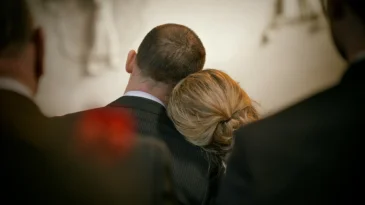


On June 20, after four years of work by the Theological Task Force on Peace, Unity, and Purity of the Church, nine months of church-wide discussion of its report, and many hours of testimony and debate in the 217th General Assembly, the Assembly approved recommendations from the task force that were intended to dampen if not end the party strife that has roiled the Presbyterian Church for decades. Fifty-seven percent of commissioners voted in the affirmative, making the task force recommendations church policy. Then, within a few hours, both a coalition of conservative "renewal" groups and More Light Presbyterians announced their displeasure with the Assembly's action and promised to promote proposals to the 218th General Assembly (2008) that would remove one or another feature of the "balanced package" the TTF said it was presenting.
Did the task force succeed or fail?
On the day after adjournment of the 217th General Assembly, I began a weekend of preaching at the Smyrna Campmeeting in Conyers, Georgia. Families have gathered at this place since 1827 for a week of morning and evening worship services. In those 179 years, the only time campmeeting was not held was the year a gentleman named Sherman was touring the neighborhood. The first campers came in wagons and lived in tents. Those with children brought a cow to supply milk, and the only air conditioning was provided by breezes and shade trees. Worship was held outdoors until an open air, tin-roofed tabernacle was built about 100 years ago. Sermons often went more than an hour.
I'd like to be totally candid and just lay open my heart about where I think we are as a denomination in the wake of the 217th General Assembly. Though I have been called a leader of "moderate evangelicals" in the Presbyterian Church (U.S.A.), I also speak as a 30-year old whose passion for Christ makes all church politics seem a distasteful waste of time, as immersed in it as I am.
In the wake of the General Assembly's recent decision to localize the determination of essential requirements for ordination, I have been receiving lots of advice. Many conservatives feel pressed with the question of whether or not we should be staying in or leaving the PC(USA). This inner turmoil results from the fact that after debating for more than thirty years about whether to ordain persons who are sexually active outside of marriage, the recent Assembly's action was the first time our denomination's policies have actually changed. By passing a new authoritative interpretation of our church's Constitution, it would appear that we have given local governing bodies the license to ordain and install individuals who live in open violation of the church's standards.
"Where do we draw a line in the sand?" I heard that question more than once as we approached the June General Assembly in Birmingham, from pastors and elders wondering what would be the outcome of the "Peace, Unity, and Purity" report with its provision for the right of presbyteries and sessions to allow "scruples" with regard to specific constitutional standards for ordination to our three ordered offices. Many are wondering if they could or should remain in a denomination that will not honor uniformly the provision of G.0106b regarding the expected sexual behavior of ministers, elders, and deacons. I confess that the question has crossed my mind as well, and thus this brief reflection on the subject.
Since the General Assembly approved the Peace, Unity, and Purity Task Force report, some of the press have been reporting that it has approved the ordination of non-celibate homosexual persons at the discretion of local ordaining bodies. The press have it wrong, and in fact the Authoritative Interpretation approved by the General Assembly has probably made it less likely that such ordinations will be allowed.
The 217th General Assembly, meeting in Birmingham, has approved an authoritative interpretation of Book of Order paragraph G-6.0108. Predictably -- and unfortunately -- the authoritative interpretation's implications for the issue of ordaining "self-affirming, practicing homosexual persons" has been the sole focus of attention by its supporters and opponents alike. Lost in the narrow debate is recognition that the process for examining candidates for ordination to ministry of the Word and sacrament is woefully inadequate in many, if not most, of the church's presbyteries. Beyond the question of examining gay and lesbian persons for ordination is the pervasive problem of the way we examine any candidate.
The reading: Matthew 25:31-40
Truly I say to you, as you did it to one of the least of these my brothers and sisters, you did it to me (Matt. 25:40).
The question that Dietrich Bonhoeffer asked himself, his students, and his readers remains as urgent now as when he first raised it: Who is Jesus Christ for us today?
Bonhoeffer by no means intended to challenge the authoritative biblical answer. What he confessed with the prophets and the apostles, he attested at the cost of his life. He affirmed that Jesus Christ is the Risen Lord who had become incarnate for our sakes in order to die for our sins and liberate us from the power of death. That was the answer presupposed in every other possible answer to his question. It was the one answer that contained all others within itself.
The PCUSA website has a statement about the G.A. meeting that reminds me of the guy who shot an arrow at a barn, drew a circle around it, and then said, "Bull's eye!" Where's Vince Lombardi when you need him telling this distracted bunch to keep the main thing the main thing? Here is another symptom of a management culture, tinkering at a great distance from men and women faithfully leading congregations across the country. It is an abomination that so many activists approach our democratic structure as a scaffold for pet projects--with unsuspecting commissioners dependent upon information they are fed.
For example, the discussions about Rec. 5 of the PUP Report never addressed the elephant in the living room. Good leadership casts vision with clear, compelling statements about a preferable future. It does not merely imply the real issue or hint at direction.
The question of ordination once again looms large on the horizon. For those of us who are Christian educators, our passionate focus rests on two overtures (12-01 and 12-02) that advocate for a fourth ordained office within the Presbyterian Church (U. S. A.) In this article I will (a) give historical and present reasons for a fourth ordained office; (b) summarize the similarities and differences between the two proposals.

Grey fog hangs heavy,
hovers,
like a decision that eludes grasp.
Rays of our burning star break through,
dispersing fog,
yet, like a direction that flits finality,
reveals but familiar banalities.
Around said star,
earth orbits and rotates,
and still we speak of sunrise and sunsets ...
routines in which, unchanged, we ever move.
Kairos, not chronos,
something new,
to scatter shibboleths.
So,
we wait,
uncomfortably together,
in a room too small,
trying to contain the damage,
until descends a Time,
a gift unmanaged ...
Peace, unity, purity.
Michael Nelms is pastor of The Yellow Frame Church in Fredon, N.J.
There has been quite a bit of discussion about what the Authoritative Interpretation of the 217th General Assembly (PUP as amended) really means for the Church. Soon our stated clerk, whose job it is to "preserve and defend the Constitution" of the church will issue an advisory opinion about what the Assembly did. His advisory opinion is important, because it will likely give sessions and presbyteries their first official word about whether, in his opinion, sexually active gays and lesbians may be ordained or installed. For now, the Office of the General Assembly has set up a page of FAQs where it asks the question, "Will gays and lesbians now be ordained," but it does not answer the question.
On October 1 2003, I wrote a letter to the Candidates Committee of the church I serve as a Director of Christian Education, and of which I am a member, inviting them to join me in a journey. It contained an application for enrollment as an inquirer in the preparation for ministry process in the Presbyterian Church (U.S.A.), and the usual transcripts, one from an undergraduate school in Nova Scotia, Canada, and one from the Presbyterian School of Christian Education, now Union-PSCE. I had served in educational ministry for twenty-three years, nineteen of them as a Certified Christian Educator, and it was time.
It wasn't time to stop doing what I was doing, or to change my focus from educational ministry to another kind of ministry, or to be more than I am, or to be someone I'm not, or to "sell out" as someone suggested I was doing. It was time for me to again affirm that the call to educational ministry in the church is a call from God, a call accompanied by spiritual gifts, a call to ministry "understood not in terms of power but of service, after the manner of the servant ministry of Jesus Christ" (G-14.0103). It was time to invite my church, my presbytery and my denomination to explore the question of what to do with a Certified Christian Educator with a master's degree from an accredited theological institution who sought to be considered for ordination to the Ministry of Word and Sacrament.
A few weeks ago I was discussing issues coming before the General Assembly with friends from around the country. We all agreed there were more than a few "hot topics" for the commissioners to debate. Someone brought up how amazed they were by the number of overtures petitioning the Assembly to keep the Montreat Historical Society open. There was laughter as he pointed out what an important issue it was.
I have to admit I was shocked. I thought everyone knew how special the Montreat Historical Society was, how much it meant, how important it was to inspire denominational loyalty. But I realized I was only one of two southerners in the conversation. The two of us began protesting that keeping open the Montreat Historical Society was indeed important, even crucial to the Presbyterian Church(U.S.A.). A friend then kindly said, "We don't get it. Please explain why this is important to the rest of the church. We want to understand the passion and the pain this decision is arousing." So I am writing this to try and convey why keeping the Montreat Historical Society open is important to so many people and to the future of the PC(USA).
c. 2006 Religion News Service
Listen up, church leaders. This parable is for you.
Dell Computer Corp. is losing a repeat customer, because their process and data requirements overwhelmed my need to buy their product.
Last week I wanted to order a $39 USB memory key. Dell's Web site required me to locate a username and password (serving their purposes, not mine). Dell's toll-free number led me into a labyrinth of voice commands. A second toll-free number landed me with a live person who insisted on creating a "profile" for me. No, I said, I simply want to make a $39 purchase.
I persevered long enough to complete my purchase. But I will think twice before making another one. No business can afford to make purchasing its products this difficult.
Your Spirit, O Creator God,
your brooding, bright imagining Spirit,
is inviting us, cajoling us, entrancing, inducing,
yes, even seducing us, beyond life into creation,
into imagination, into all the shapes and hues,
the textures, postures, melodies of grace.
So let that flaming, flagrant Spirit
be afire now among us here.
Lift our imaginations through the laughter of the soul.
Restore to us our poetic vision,
that we may see this world anew
as your mighty work-in-progress,
that we may see ourselves as others see us,
that we may see you, the unseen God,
as the source and goal and heart of all delight.
Through these moments of welcoming,
of sustenance, of encouragement, mirth and wisdom,
move up, across, among us once again
with your Spirit of inspiration and of ecstasy.
We ask this in the name of the living Word,
that Word we seek and find and lose,
and then are found by.
Let us say . . . AMEN.
As Americans brace themselves for yet another hurricane season, they might look at one congregation and its response to the Gulf Coast disaster. Perhaps it will become a blueprint for the future.
Suspended between Orlando and Daytona Beach is a small town, DeLand, Fla., home to Stetson University. Across from the campus, along a major tree-lined boulevard, is First Presbyterian Church, a congregation of 550 (Web site: www.firstpresdeland.com .)
In 2004, when hurricanes Charley, Frances, and Jeanne hit Central Florida, residents were sensitized to the pain caused by evacuations, flooding, damaged homes, and lack of electricity. The face of suffering was personal. Then Katrina slammed into coastal Mississippi, Louisiana and Alabama, touching the hearts of DeLand's people like Jim and Rachael Winter, Mississippi natives.
The 2006 General Assembly will be remembered as the Assembly that debated two controversial issues. The first was raised in a petition entitled "A Voice for the Local Church." The petition gave expression to a widely shared concern of congregations that recent administrative changes had fundamentally altered the nature of the Kirk, that too much power had of late been transferred from the local church and Presbytery to a few people within the Central Administration.
Because of our successful remedial complaint (Johnston et al vs. Heartland Presbytery) I have received mail from commissioners to this month's G.A asking my view on the current overture to make per capita payments mandatory. Here is my response.
If the proposal to force all churches to pay per capita is passed:
I have a mischievous habit of asking pastors the question: "What's going on with your church on Thursday afternoon?" Their predictable answer is usually some equivalent of "nothing much."
That question was provoked by the chapter title in a book I read a few years ago, Where Is the Church on Thursday Afternoon? The response of most pastors is a predictable "Christendom" answer. After all, the church is about the clergy and about properly authorized services and sacraments and the custodial care of passive members. Responders think only of the "church gathered" for its meetings and assemblies, and under the supervision of the church's duly ordained leadership.
Editor's Note: Outlook editors recently interviewed two young Presbyterian members of "Pro-Seed", named after the biblical mustard seed and aimed at spreading the Kingdom of God and creating a new culture within the church. Each represents a different perspective on the issue of abortion. Fairlight Collins Jones is an ordained Minister of Word and Sacrament and co-pastor, with her husband, Scott, of Woodland Church in West Philadelphia, Pa. She graduated from Pittsburgh Theological Seminary in 2002. Nancy Neal is an elder ordained at Lafayette Avenue Church in Brooklyn, N. Y. She has an M.Div. from Union Theological Seminary in New York and is a candidate for ministry. She works at The Crossroad Publishing Company in New York. The questions and answers have been edited for length.
Among the theological questions before the 217th General Assembly will be those in the draft Pastoral letter and list of five sacramental practices recommended by the Sacraments Study Group for a two-year period of discernment in congregations.
This group was convened by the General Assembly Office of Theology and Worship to address several referrals from previous assemblies having to do with the formula of invitation to the Lord's Supper. Most of these overtures suggested ways of altering the language used in the invitation so that explicit mention of baptism as a requirement for admission to the table would be removed. Apparently, in many congregations, such references to the requirement of prior baptism were seen as barriers to outreach and the welcoming of newcomers to the church.
This coming June, the 217th General Assembly will be considering the long-awaited report of the Theological Task Force on Peace, Unity, and Purity of the Church (PUP). Some left-of-center and right-of-center groups in the church view the report as inadequate in addressing the hot issues before the church, particularly the question of ordination. To be sure, the PUP report affirms some key themes in the Reformed understanding of ordination and vocation, such as mutual self-giving and service, as well as the communal and covenantal nature of God's call upon the Church and those called to serve in ordained leadership (pp. 19-20, Final Report of the Theological Task Force on Peace, Unity and Purity of the Church). Even so, the PUP Task Force expresses a great disappointment:
... Scripture does not provide a thoroughly developed theology of ordination, and a theology of ordination has not been clearly and consistently articulated in the development of Reformed and Presbyterian doctrine. (lines 565-567, Final Report)
When I attended a gathering in Pasadena five years ago to discuss the doctrine of the Trinity, I had no idea what I was getting myself into. Charles Wiley and others from the Office of Theology and Worship were holding a series of forums around the country in response to an action of the 2000 General Assembly that a group be constituted to study the doctrine of the Trinity in the theology, life and worship of the Presbyterian Church (U.S.A.). I was intrigued by the idea that the Assembly had called for a theological discussion. Before the Theological Task Force on Peace, Unity, and Purity and before "Hope in the Lord Jesus Christ," the Trinity Task Force (now a "Work Group") was the first time a theological committee had been formed at the GA level since reunion in 1983.
The task force on the Trinity rightly comments (line 71) that the doctrine of the Trinity is "widely neglected or poorly understood in many of our congregations." This central doctrine of the Christian faith seems optional to some Presbyterians, peripheral to others, and irrelevant to the faith and life of many others. For some ministerial candidates, the doctrine of the Trinity does not appear on their carefully crafted statements of faith presented to their presbyteries. The task force rightly concludes, after observing this reality in our church, that "the doctrine of the Trinity is crucial to our faith, worship and service" and it prays that "Presbyterians will once again find that the doctrine of the Trinity is good and joyful news!" (lines 72-74).

I am recovering from a devastating downsizing of our national offices in the Presbyterian Church (U.S.A.) We have just gone through a drastic restructuring familiar to many people who live in the corporate world. And this downsizing was done with all the corporate tools available to this mindset. The exception was the worship services we held as a community of faith, but even those services were tainted with corporate residue.
© Copyright 2026 The Presbyterian Outlook. All Rights Reserved. Privacy Statement. Website by Web Publisher PRO