


It is fitting for The Presbyterian Outlook to salute the Martin Luther King Jr. holiday by remembering what tireless advocates Dr. E. T. Thompson and Rev. Aubrey Brown were for racial integration and justice. (Thompson was the Outlook's first editor and professor of church history at Union Seminary in Virginia; Brown was editor from the 1940's to the 1970's.) This paper stood tall on these matters when such beliefs were dangerous to espouse.
When Thompson was tried for heresy in Mecklenburg (now Charlotte) Presbytery, everyone understood that the sub-texts of that trial, ostensibly about the faithful interpretation of Scripture, were his positions on integration and ethics. Because of the malign interweaving of biblical inerrancy with segregation in the South, people who agreed with Thompson and Brown were labeled communists by fundamentalist Presbyterians.
The 50th anniversary celebration of the landmark 1954 Brown v. Board of Education Supreme Court decision was a necessary spotlight on that ruling’s profound contribution to goodness in this nation. With the commemoration over, that spotlight becomes a searchlight, seeking us out in the darkness where in an audience we sit, comfortably, when it is our turn to take the stage.
"What time is it?" is one of the most frequently asked questions, and no one wearing a watch has difficulty answering it. But change the wording slightly and mystery abounds. "What is time?" has been pondered through the ages and we think about it especially at the coming of a new year. Time is elusive--you can't smell, taste, hear, or see it even though you may have a lot of it on your hands!

Two quotes I saved from a piece in the New York Times called "The New Designer Despair," take issue with a destructive tolerance that leaves souls shriveled and minds tired. The subject was education in moral judgment. The writer quotes the principal of his daughter's school: "We encourage our children by telling them that there are no bad ideas." He also references Modern Times by the English, Roman Catholic historian, Paul Johnson: "the church is the last place in the world where we make the distinction between good and bad ideas."
If the biggest, baddest, and best story of 2004 is religion, religion in politics and public life, then the designer despair generated by too much tolerance is gone. There are scores of religious people who tell us what is good or bad. The presidential election was shamelessly religious. Jerry Falwell ran a partisan voter registration campaign in countless congregations, and Democrats cast their usual nets into African-American churches.
Scripture Readings: Deuteronomy 8:1-3, 6-10, 17-20; Psalm 65:9-14; James 1:12-18, 21-27; Matthew 6:25-33
”You crown the year with goodness, O God, and your paths overflow with plenty.” Amen.
How long do you suppose it has been since we have talked about – or even allowed ourselves to feel – a sufficiency of anything?
The morning routine at our house calls for reading the letters to the editor of the New York Times. Since the election, that’s become something of a trial. More often than not, the letters have to do with the role of “religion” in politics. Many letter-writers see the nation divided between the devout, who are concerned for “moral values,” and the secular, who are presumably interested in issues that have nothing to do with “morality,” such as war and peace, and the obligations of the rich toward the poor.
Brothers and Sisters in Christ,
Is peace possible?
I have been increasingly troubled by our continued reliance on the “just war” theory as a path toward credible peacemaking. In the last three years, my chagrin has grown to an almost visceral discomfort with the rhetoric and the reality of the “war on terrorism.”
Union Seminary had let out for the 1957 Christmas holiday, and I had come home, looking forward to being with my parents, and to sharing the good news that I had "met someone" with whom I might get serious. As I looked about the neat little house my parents had just built in the York County, S.C. countryside, I noticed that there was a new woman keeping watch over the modest Christmas display.
As the first faint light of Christmas cast its imperceptible glow around the celebration of Thanksgiving, I preached and celebrated the Lord’s Supper in the renovated chapel at an ecumenical Christian community, Richmond Hill.
The fallout from Presbyterian actions involving the Middle East continues to rain down.
On Nov. 11, the denomination announced that it no longer employs two Presbyterian Church (U.S.A.) national staff members who traveled to the Middle East last month and were involved in a controversial meeting with Hezbollah, a group that the U.S. State Department lists as a terrorist organization.
Gone are Kathy Lueckert, who as deputy director of the General Assembly Council was considered part of the top level of the denomination's leadership, and Peter Sulyok, coordinator for the past dozen years of the Advisory Committee on Social Witness Policy.
In announcing the departures, John Detterick, executive director of the General Assembly Council, did not make it clear if Lueckert and Sulyok resigned or were fired -- or say precisely why they no longer are PC(USA) employees, citing in a written statement their right to confidentiality.
But the Hezbollah visit, made during a two-week fact-finding tour by the Advisory Committee on Social Witness Policy -- a visit that also included high-level meetings with political, human rights and religious leaders around the Middle East -- had provoked strong and immediate criticism both from Jewish leaders already angry with the PC(USA), and by some from within the Presbyterian church.
Presbyterian-Jewish relations have been tense since the General Assembly's decision, last summer, to begin a process of phased, selective divestment in some companies doing business in Israel, in protest over Israel's treatment of the Palestinian people.
Editorial note: Retired Presbyterian pastor Ralph Bucy in the December 20/27 2004 issue of the OUTLOOK in his opinion piece "Beyond Reinhold Niebuhr" writes about Christian Realism and current events. It responds to an OUTLOOK editorial of November 1 entitled "Where is Reinhold Niebuhr?" by O. Benjamin Sparks. Since this editorial appeared while the OUTLOOK web site was inactive, it and Bucy's response appear below.
on Isaiah 9:2b-7 and cities of no refuge:
Tehran, Baghdad, New York, Sarajevo, Beirut, Hanoi, Selma, Nagasaki…
The warriors’ tramping boots their martial cadence count
dawn to day to dusk to dark by sighs.
With this issue The Presbyterian Outlook introduces the columns of Ron Ferguson, who was a journalist before attending divinity school and becoming a Presbyterian minister. He studied at St. Andrews, Edinburgh, and Duke Universities. Ron began as a pastor in a huge public housing area in Glasgow, Scotland, called Easterhouse (a place more like Gethsemane and Calvary than Easter).
Editor’s Note: This presentation was made at the recent Dialogue on Anti-Semitism at Fuller Theological Seminary in Pasadena, Calif. The speaker, Sari Ateek, was presenting the night’s dialogue participants, Rabbi Dr. Elliott Dorff and Fuller President, Dr. Richard Mouw.
Before I introduce our two speakers for the evening, I’d like to share with you a few personal remarks. When I was first asked to do the introductions for this dialogue, I have to admit that I found myself initially hesitant for at least a couple of reasons.
In Meredith Wilson’s enchanting musical, “The Music Man”, Prof. Harold Hill comes to River City and tricks the whole town into buying his mail order musical instruments for a new children’s band. The parents are dubious, but the kids are excited. On the day of the promised delivery, they wonder in song if there is anything coming “for me”.
Gratitude, if and when it does arrive,
seems very seldom centered on the meal itself.
Yes, the sacred bird with all its panoply
is blessed in solemn, if embarrassed grace.
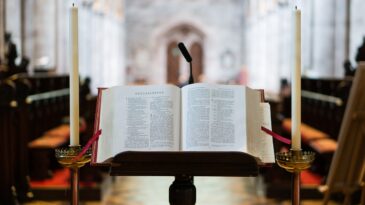
Reformation Day (which this year – perhaps too appropriately – fell on Halloween) provides a needful occasion on which to reflect on the role of Scripture and preaching in the Presbyterian Church. The matter is made urgent by the recent election that sacrificed (at a cost of 600 million dollars on the presidential race alone) substantive debate about the serious issues before this republic on the altar of entertainment, spin, and downright dirty lies.
Celebrate, Celebrate, Celebrate said the words of the theme song for the 24th General Assembly of the World Alliance of Reformed Churches (WARC) held in Accra, Ghana, July 30-August 13, 2004. It focused on the Scripture assuring life in fullness (John 10:10). The words and the tune reverberated throughout the campuses of University of Ghana, Legon and the Ghana Institute of Management and Public Administration (GIMPA).
Does there come a time for everyone
when looking forward yields
to looking back; when fond memory
takes over from anticipation
and what has been holds pride of place
At this time of year it is worth thinking about our attitude toward God in prayer. So many negative things happen in our own lives, the church, and in the world that are dangerous and disheartening. we often start our prayers by listing our fears about potential disaster. As a denomination we run the risk of constantly focusing on our disagreements, our declining membership, and our lack of power in the world.
It was my privilege during August this year to visit both Guatemala and El Salvador. I was in Guatemala in the company of my son Herb, who is a journalist/editor for the Diocese of Michigan. We then joined a group of Episcopal communicators for a week in El Salvador.
It is a prayer heard in almost every synagogue and church
throughout the world:
"May the Lord bless you and keep you; may the Lord
cause his face to shine upon you and be gracious unto you;
may the Lord lift up his countenance upon you and grant you peace."
The PC(USA) lost two outstanding leaders almost exactly a week apart with the deaths of C. Kenneth Hall on October 15 and Shirley Guthrie on October 23 (see obituaries in the November 8 and today’s issues of OUTLOOK). Both exercised extraordinary spiritual gifts in lives wholly committed to the gospel of Jesus Christ and to ministry in the Presbyterian Church (USA).

It’s clearly possible that we Americans need to distinguish between what has been given us by the hand of Almighty God, and what we have wrested by exploitation from others who were in this land before we were, as well as from those who were brought to the ‘New World’ against their wills and purchased by us, and as our property made enduring contributions to our national wealth. Thanksgiving is a peculiar American holiday.
I planted, wrote Paul to the Corinthians, Apollos watered, but God gave the growth. (I Corinthians 3:6)
This image of the church is a flourishing plant, a living organism with deep roots, firm foundations, and tender branches. I am concerned about the tender branches, especially as they matriculate each year in church conference centers.
© Copyright 2026 The Presbyterian Outlook. All Rights Reserved. Privacy Statement. Website by Web Publisher PRO