


In his recent article, George Hunsinger offers thoughtful reflections on the present impasse in the Presbyterian Church. His proposed "third way" is..
Professor Migliore’s proposed interpretation of G-6.0106b, while not impossible, is by no means necessary. If we stick to the direct wording of the text, and do not read things into it which are not there, then a different interpretation is more to the point. G-6.0106b simply states what is true by definition. There are either those who are married (one man and one woman), of whom fidelity is required, or else those who are unmarried (single), of whom chastity is required, as it is of all Christians.
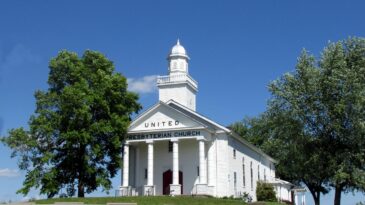
If we are to move beyond the theological impasse tearing at our church today, it may be wise to revisit the lessons American Presbyterians have learned over the decades concerning the confessional nature of the church.
That there is a dispute about Presbyterian confessional identity today is nothing new. Such disagreement goes all the way back to the colonial experience. From the early 1700s there were two ways of thinking of Presbyterian confessional identity.
Since a majority of subscribers to The Presbyterian Outlook are not graduates of Davidson College, I am providing the proposals that will come before its Board of Trustees meeting that began Feb 3rd. These proposals were presented for a ‘first reading’ at an October board meeting and have been in the hands of college alumni/ae since early December.
Those of us who take the teachings of John Calvin as our theological base have always practiced -- or are supposed to practice -- a faith-based initiative toward the society in which we live. Calvin constantly emphasized the primacy of the community over the individual, teaching that we are bound together and must take responsibility for each other, not just in the church, but in the community at large.
The 35th anniversary of the Confession of 1967 falls this year. A few members remain, both of the committee that drafted the document, and of the committee that received and modified it somewhat in 1965, prior to its circulation in the presbyteries during 1966 and the first half of 1967.
Writing recently in The Outlook, Editor Robert Bullock recognized that annual meetings of the PC(USA) General Assembly seem to be hurting the church and bringing unnecessary division. He wrote: "Annual meetings allow divisive issues to be brought up every year with the potential for win-lose votes at the meeting and in the presbyteries . . . . Dealing with divisive issues year after year through an annual meeting of the General Assembly has not been a plus for the Presbyterian Church (U.S.A.).If an institution’s national gathering does more harm than good to the institution, shouldn’t the institution consider seriously having the meeting less often?"
It has come, its supporters say, from the grassroots – and it has grown fast enough that people wonder out loud whether the confessing church movement now is a force that must be reckoned with in the Presbyterian Church (U.S.A.).
In fewer than nine months, the sessions of more than 1,100 congregations – about 10 percent of all the PC(USA) churches – have signed confessional statements, most of them describing belief in the Lordship of Jesus, the authority of the Bible and the sanctity of marriage.
I was overjoyed when I read that one of the proposed amendments coming out of this year's General Assembly was aimed at simplifying and shortening Ch. 14 of the Form of Government. It has seemed for years that every edition of the Book of Order was bulkier than the last. Much of that bulk came from items better handled in a manual of operations. My delight turned to horror, however, when I found hidden in the midst of the revision of Chapter 14 a provision that would allow the interim pastor of a congregation to become its next installed pastor by a two-thirds vote of the presbytery.
We Presbyterian evangelicals like to appeal to the past in our ongoing debates with those who claim to have received "more light" on certain important subjects than was available to the biblical writers and the 16th-century Reformers. And rightly so. A defense of both biblical authority and the normative status of our confessional heritage has never been more urgent.
On this subject more than usual a reader might wonder what possible insight I could possess. Until now, I have been quite content to recognize the mystery of feminine wilds without devoting any imaginative energy to reflection on what it must be to have them. Most likely this restriction comes from being told as a little boy that if you kissed your own elbow you would turn into a girl.
He's been coming to our church lately. Not very well dressed, obviously from the street. Totally out of place in our fine building. We've got lots of street people who come into and out of our life.
Criss-crossing the country by car the way I do, I've been fortunate to have had few breakdowns. Other than hitting a cement abutment along the Ohio Turnpike and locking my keys in my car while stopping along a deserted stretch on the Pacific Coast Highway, nothing notable has happened.
This is an activist generation. It is reflected in civil life, national politics and the ecclesiastical scene. In a way this is good: many things need to be done, but too often we try to do too many things or even the wrong things -- so long as we're getting something done.

Despite late November spring-like temperatures, the fiery red, golden passion of October's glory has fallen fast. From the mighty oak, maple and ash, the crippled stem and crinkled leaf have tumbled down to the hard, hard ground, where they are crushed like fodder under the hoof of the deer and the boot of the hunter.
We live in a world without mercy, where more and more people feel trapped. Time and money have established their merciless rule. The secret of their power is scarcity. Time is money, they say. Those who have a lot of money never have time, and the poor perhaps have time but no money. Yet they need money in order to live, so they borrow, and then they find themselves trapped in the relentless grip of debt.
Angelic University Graduates and Faculty:
Thank you, graduates, for allowing this old angel, class of '04, to address you on graduation day. And I thank the president for granting me the degree of Doctor of Celestial Deeds (DCD). Think of it! I, Gabriel, a doctor!
Let me recall some of my big jobs, since I have been asked to share memories of my life with you. I was a Special Cosmic Messenger, delivering the Fear not! master message on at least three big occasions.
The baby grows up into
Mercy
"Jesus" by name -- the Lord saves, or will, as it reads
in the original
His denizens give dozens of titles --
"Lord," "Almighty," "Prince of Peace" even this year,
I head into Greene's Discount Beer, Wine and Liquor. A Salvation Army guy wearing a camouflage cap and jacket over blue dungarees and ringing a bell holds the door open for me. The multiple incongruities slip into my brain. I check; he has a Salvation Army name badge.
Inside, the cashier asks for my I.D., startling me. It's not my age -- 58 -- she wants, but verification of my credit card. I laugh and thank her for checking.
Are you looking for something special to lift your spirits this Christmas? What about a gift that can't be purchased? Namely, the gift of enthusiasm. The seed of genuine enthusiasm is God-given, lying deep within the soul of everyone. The emergence of enthusiasm depends on the maturity of one's walk and talk with God. The nature of enthusiasm (see your dictionary) is to be God-possessed and infused with new energy.
Recently I watched on television as President Bush signed the Aviation and Transportation Security Act, making airport security a direct federal responsibility. A week earlier, Congress seemed to be deadlocked regarding airport security, with neither party willing to compromise on their own strongly held positions. But, within days, the Senate and House had both agreed to a bill which the Senate passed without opposition and the House passed by a vote of 410 to 9.
In their proper place, I have long, and roundly, maintained a lowdown admiration for nice, big Presbyterian buts. To close and appreciative observers like me the fundaments of Reformed dogmatics are both ample and shapely with lots of wiggle room. Being generously endowed (and with intelligence, too), Presbyterians are aware that many theological affirmations are so complex the only proper response to them is, "yes, but...."
1. A Third Way requires a new mode of thinking. At first glance it is bound to seem implausible.
2. Without a Third Way, our church is in danger of shattering.

There are several reasons why congregational visitation is no longer a priority; the difficulty of arranging it; members are busy; pastors are busy; and we are not sure what it accomplishes.
There are several reasons why congregational visitation should be a priority. It meets people where they are; it facilitates contact with members who seldom are seen; and it can renew the church.
"Resolutions acknowledging the Catholic Church as part of the body of Christ, and calling for continuing study of those practices which first divided us were approved, as was a resolution of invitation to invite the U. S. Conference of Catholic Bishops to join in studies leading to possible future affirmation of one another's baptisms."
 -- 213th General Assembly News (June 13, 2001)
© Copyright 2026 The Presbyterian Outlook. All Rights Reserved. Privacy Statement. Website by Web Publisher PRO