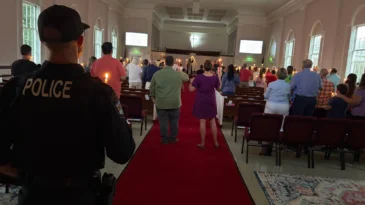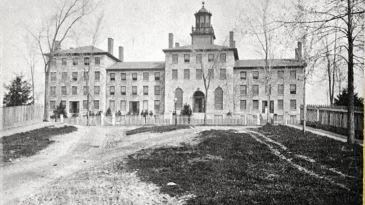



There are several reasons why congregational visitation is no longer a priority; the difficulty of arranging it; members are busy; pastors are busy; and we are not sure what it accomplishes.
There are several reasons why congregational visitation should be a priority. It meets people where they are; it facilitates contact with members who seldom are seen; and it can renew the church.
"Resolutions acknowledging the Catholic Church as part of the body of Christ, and calling for continuing study of those practices which first divided us were approved, as was a resolution of invitation to invite the U. S. Conference of Catholic Bishops to join in studies leading to possible future affirmation of one another's baptisms."
 -- 213th General Assembly News (June 13, 2001)
It's time to get serious. The intramural debates preoccupying the PC(USA) look rather trivial and self-defeating when compared to the all-too-real challenges now facing the world in the aftermath of Sept. 11. With commercial jetliners having been turned into weapons of mass destruction; with biological weapons having been directed, however crudely, at news agencies and government leaders;
The 213th General Assembly (2001) directed the Office of Theology and Worship to develop materials to "help the church better understand the theological richness of the Lordship of Jesus Christ."
Everything changed on Sept. 11, including world mission. Our staff in Worldwide Ministries in Louisville did a good job of immediately contacting all of our mission workers around the world.
We shared the joy and privilege of serving as co-chairs of the Joint Committee on Presbyterian Union, from 1969 to 1983. Like many of your regular readers we rejoiced in the breakdown of barriers which had stood for 122 years, and the creation of a newly reconciled church, the Presbyterian Church (U.S.A.).
A connectional presbytery in this Internet culture is a wired presbytery. An underlying theological premise driving this concept is the realization that God has providentially placed us in a technologically advanced period. Not to use the communication media available to us for advancing the gospel would be like the Apostle Paul deciding not to write letters.
Six years ago the General Assembly elected me to a new class of the Assembly's Permanent Judicial Commission. Elections occur every two years. They create, if you will, three two-year sessions for each commissioner. Every two years this transition brings an interesting change of style and personality as the new class arrives. Each new class constitutes at least a third of the membership.
My mother's twin sister married a Methodist minister which, in those days, was not considered a serious disgrace. His first pastorate was in Calico Rock, Arkansas, and after a series of calls (or raises) to larger churches he was elected a bishop. Soon after this elevation, I told my uncle the only thing he could now aspire to become was any kind of Presbyterian.
When you were a kid was the "True Church" the subject for a month of church school lessons? Did you hear lots of sermons on it; was there a "True Church Sunday" with a special bulletin cover and all? Did you sit around the Sunday dinner table discussing the "True Church" with Mom and Dad and perhaps Preacher Ned? Did you have the conviction as communicant class ended that soon you would be a member of the "True Church"?
In PC(USA) Polity Reflections Note 43, the stated clerk and the Constitutional Services Department answer questions that have been asked about the amendments to G-6.0106a and which the 213th General Assembly sent down to the presbyteries.
As the chair of the drafting committee that prepared the report adopted by the 1978 General Assembly (UPCUSA) on the issue of homosexual ordination, I was stunned by A. J. McKelway's claim that the definitive guidance it provided answered a question that was not asked, and thus "got us into this mess" (Outlook, June 18). Having reread the record, I beg to differ.
Commenting on the precarious state of relations between the Unionists and the IRA in Northern Ireland, commentator Andrew Sullivan of The New Republic recently stated in his weekly TRB column:
"You cannot negotiate peace with people [the Irish Republican Party] whose power is entirely dependent on the will to wage war.
Amendment A is the latest attempt to permit the ordination of practicing. homosexuals. Having failed to reinterpret the clear and consistent words of Scripture, and having failed to overthrow the church's traditional teaching on sexual behavior and marriage, proponents of homosexual ordination now turn to polity.
1. We have to get past the idea that we are the answer to the problems in the world, instead of Christ being the answer.
By letting go, we free ourselves to serve. Letting go of what? Fear, ego, pride, self-interest -- our own agendas. Empty yourself of these so you can receive God's gifts. We are not Christ, but we can be his hands and feet.
Many of us know that true peace often comes only after some kind of conflict. In the case of the wars that have made and kept this nation free and peaceful, a freedom and peace we celebrate this week, the conflict has been terrible. It has cost people their lives or the lives of those they loved; it has scarred others for life, physically and emotionally.
One of the most remarkable stories of the 213th General Assembly happened before commissioners arrived in Louisville. Advocates for 33 overtures, from 26 presbyteries, conferred among themselves in the weeks prior to the Assembly. I was one of them.
According to the polymathic Philip Schaff, Lutherans produce the best scholars but the Reformed community produces the best preachers. I grew up agreeing with Schaff about the latter but not the former. Our small Presbyterian Church – located at the beginning and the end of the road for ministers – nevertheless provided appropriately learned pastors for our little fellowship.
R. David Steele, 70, a widely known herald of hope and joy among Presbyterians in the PC(USA) died Tuesday, Aug. 28, of cancer in Sun City, Ariz.
A pastor, author, homespun philosopher, poet and humorist, he was known to many readers  of The Outlook for his regular column "Tuesday Morning" written by him since February 1985.
Before proceeding, you need to read the strange little story in Numbers 15:32-36.
This passage from the ancient world has an important connection with a prominent object in our present world, to wit: the moon. Now a family magazine should be careful about what it exposes. Therefore, at least one of the current uses of the term "moon" will remain decently covered by being uncovered here -- uncovered in the sense of being roundly undescribed.
Ted Wardlaw stood at the microphone, waiting his turn to speak during the 213th General Assembly's debate over removing the "fidelity and chastity" rules for church officers.
Following World War II, men flocked back to churches, bringing their families with them. In the 1950s and early '60s, 40 percent of Sunday congregations were male, and 3,000-5,000 men attended national gatherings at the Palmer House in Chicago. As late as 1991, 1,000 men attended a gathering in Louisville.
So they took branches of palm trees
and went out to meet him,
crying, "Hosanna!"
-- John 12:13
"You academicians need to draw in religious leaders," stated the strong Muslim politician Naledi Pandor as she addressed the International Academy of Practical Theology in Stellenbosch, South Africa, on April 6.
The Library of Congress and Montpelier, Va., are holding 250th birthday celebrations this year for James Madison, fourth President of the United States. Although not as well-known as more deistic celebrities Washington and Jefferson, the Virginian deserves attention as the chief architect of the Constitution and Bill of Rights of the new United States of America.
In his report to commissioners given at the beginning of the 213th General Assembly, outgoing Moderator Syngman Rhee fervently called for "a more excellent way," a way based on love and mutual forbearance as set forth by the Apostle Paul in 1 Corinthians.
© Copyright 2026 The Presbyterian Outlook. All Rights Reserved. Privacy Statement. Website by Web Publisher PRO