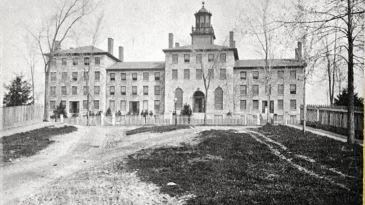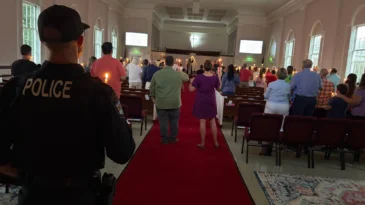


You barely have a chance to say farewell to Jim Andrews, and you have to say farewell to Bill Thompson, too. As the final stated clerks of the southern and northern streams, Jim and Bill together helped engineer the reunion--at the cost of one's continued ecclesiastical employment. Two decades later, their entry into the church triumphant just a few weeks apart assures that the former counterparts are both employed again, partnering in the promotion of God's reign through the cosmos.
Their legacies of leadership challenge their successors of today and tomorrow to excel
Acts 15: 1Then certain individuals came down from Judea and were teaching the brothers, "Unless you are circumcised according to the custom of Moses, you cannot be saved." 2And after Paul and Barnabas had no small dissension and debate with them, Paul and Barnabas and some of the others were appointed to go up to Jerusalem to discuss this question with the apostles and the elders. ... 4When they came to Jerusalem, they were welcomed by the church and the apostles and the elders, and they reported all that God had done with them. 5But some believers who belonged to the sect of the Pharisees stood up and said, "It is necessary for them to be circumcised and ordered to keep the law of Moses."
Let's shift the issue before that body, ever so slightly. Let's focus, not on circumcision, but on another important issue for the Jews.
As the General Assembly receives the report of the PUP Task Force and starts to discuss it, one simple question ought to be on our minds: What are our alternatives?
One, the GA can approve the report. This could lead to pressure for schism and anger breaking out because now Presbyterians will essentially permit an action that by vote of presbyteries three times in the last twenty years we have refused to approve.
Editor's Note: This year the General Assembly of the PC(USA) will meet concurrently with the GA's of the Cumberland Presbyterian Church and the Cumberland Presbyterian Church in America. This is the first of a two-part series of articles on those sister denominations.
On February 3, 1810, three riders left Logan County, Kentucky. Their destination was Dickson County, Tennessee. Specifically, they sought the farm of Samuel McAdow near Burns, Tenn. Two of the riders, Finis Ewing and Samuel King, had been ordained as ministers by the Presbyterian Church since 1803 and 1804, respectively. Ephraim McLean, the third rider, had been a probationer since 1803. Samuel McAdow had been a Presbyterian minister considerably longer. Although the exact date of his ordination is unknown, McAdow had been ordained by 1796, possibly before. The dates of ordination of these frontier preachers are significant, as are the circumstances in which they found themselves in 1810.
Having been going to GA's for thirty years and serving on the GAC for five years and as an executive presbyter in the past, I offer to you four barometers of where the PCUSA may be going. I do not think that they will happen as described, but they may. It is much more likely that some of them will happen.
Popular fascination with Dan Brown's novel The Da Vinci Code continues unabated. The book has been on the bestseller list for more than 160 weeks with more than 10,000,000 (that's 10 million) copies sold. The May 19 release of the feature film based on this fast-paced adventure story and starring Tom Hanks as the handsome scholar Robert Langdon exposes Brown's provocative and disturbing ideas about Jesus Christ and early Christianity to an even larger audience. A directive from the Vatican urging Roman Catholics to boycott the movie will probably only increase the desire of some people to see the film.
c. 2006 Religion News Service
I'm not sure if I've ever seen such an explosion of public interest in Jesus -- from a variety of angles old and new (some would say odd). Whether this fascination simply means that Dan Brown's The Da Vinci Code has created a new industry, or whether it signals something deeper -- that's up for debate. As a pastor with 24 years of ministry experience in a nontraditional setting and as an author on related matters, I think it's a good measure of both.
Through this resurgence of interest in the known Gnostic gospels, through intrigue surrounding the newly discovered Gospel of Judas, as well as through interest in all things Da Vinci, Americans are expressing, I believe, a simultaneous spiritual disappointment and hope -- and each has live political ramifications.
Conspiracy Theory. Loved the movie. Mel Gibson and Julia Roberts put on a show.
This year's conspiracy theory installment, The Da Vinci Code movie, based on the wildly popular book out for several years, promises to sell many more tickets than the Gibson-Roberts film.
Americans love conspiracy theories. Attributing the worst motives to "those other people"--especially if they represent the bureaucracy of government, law enforcement or the religious establishment--pulls readers and viewers into a web of juicy intrigue. It makes high entertainment.
But conspiracy theories prove less entertaining to those falsely accused of such conspiring.
As we near the end of another school year, those of us in theological academia ready ourselves for Baccalaureate and Commencement exercises yielding yet another crop of pastors who will soon stand behind pulpit and table in churches all over the country. This will be my first opportunity as the new president of Pittsburgh Theological Seminary to pass out diplomas and wish our graduating seniors well as they take on a new mantle of responsibility.
What will I be thinking as I shake their hands? I will be thinking about a line I said to our program staff at First Church, Dallas at the end of every staff meeting. It was, "Praise the Lord," to which they replied, "The Lord's name be praised." Then I always added a phrase from Hill Street Blues, "Be careful out there." My reason for saying this line to 2006 graduates is that I've just come back to the academic world after 22 years of parish ministry in one congregation, and I know it's not easy being a pastor these days.
In many ways the church that today's graduates are heading into is not the same one I faced 33 years ago. The world is not the same either. As a result I want to encourage our soon-to-be clergy to "think outside the box" in two ways as they leave their places of learning.
Starting a pastorate is extremely stressful. Sky-high expectations abound! At risk is much more than a job and financial security, but also the emotional and spiritual well being of a family and congregation.
Most pastors recall surprises as they discovered their congregation's unwritten rules. Early in my first pastorate I asked where the pulpit was typically located. I was told the interim pastor had moved it around, which I took to mean that I could as well. I was wrong. The pulpit belonged in the center of the chancel, as everyone knew. I'd been "had" in a game of "gotcha." In this case it only cost me a few credibility points. In my next pastorate, I served "communion wrong" for months before finally figuring out the "right way." I was a source of esoteric entertainment as "those in the know" chuckled at my awkward ways. Hey, I don't mind being a fool for Christ, but some mistakes can be very costly.
Enter clergy coaching.
Several years ago, in the early months of my new position as a seminary president after 23 years of parish ministry, my older daughter, then a ninth-grader, came home from school one afternoon and shared with me a conversation she had had that day with a teacher. In the midst of discussing something else, the teacher had startled her with the question, "What does your father do?" She told me she began to swell with pride as she answered, "My father is the new president of Austin Presbyterian Theological Seminary here in Austin." There was a pause, she said, after which the man asked, "What's a seminary?"
What is the shape of good pastoral ministry, and how is it nourished for a lifetime? How can pastors develop and sustain vital ministry that nimbly navigates the shifting sands of the world in which we live and the wide-ranging expectations of congregations, while remaining steadfastly faithful to the Gospel? Pastors are expected to discern and respond appropriately to their congregation's particular culture, to shape their ministry in ways that fit the situation while remaining faithful to Jesus Christ. Negotiating emerging ministerial challenges gracefully and effectively requires of pastors the capacities to discern the real needs of the moment and to exercise whatever skills and manners are needed to meet those needs appropriately. Moreover, the will to learn and adopt these skills and manners requires that pastors bear the dispositions of eager learners and willing servants.

Stewardship is a subject everyone in the church seems to think is extremely important, but in most churches it is the one aspect of ministry we do the poorest. All too frequently ministers blame the seminaries for failing to teach them how to develop a good stewardship program. Everyone tends to blame someone else--the seminaries, one of the governing bodies of the church, the ministers, members of the church--for being stingy.
Where does the blame belong?
If forty-one years in the ministry have taught me anything about stewardship it is this: people need to be taught the why, the how and the when of a healthy stewardship program.
Biblical scholar David Lull was discussing the Gospel passage in which Jesus tells a wealthy man asking the path to eternal life to sell all he has and give the money to the poor.
When the man walks away sad, according to the passage in Matthew, Jesus turns to his disciples and says, "And again I say unto you, it is easier for a camel to go through the eye of a needle than for a rich man to enter into the kingdom of God."
Lull suddenly looked up and asked the class at Yale Divinity School:
"Who is the rich man?"
In I Samuel 24 we read about a piece of cloth with a wonderful history and a powerful symbolism.
The chapter begins with the news that Saul has returned from fighting the Philistines. He is told that David and his men are hiding out in the wilderness of En-gedi. Saul has also been after David and wants to eliminate him from the kingdom. Saul immediately takes off for the wilderness of En-gedi with three thousand men. It is a large force, but it is not only the size the text wants us to notice. The reference to the men being from "all of Israel" is to suggest that Saul has support from all the people for his campaign against David and his followers.
Editor's note: In the March 20 issue of the Outlook, part of this poem appeared as the lectionary for March 26, 2006. It was not until it was printed that the writer and the Outlook discovered that it was an earlier version and a later version including a further section had not been transmitted to the magazine. We are now running the poem in its complete form for further inspiration and edification.
I've never been bitten by a serpent
although one early dawn hour
I was awakened by my brother
who appeared quite happy
having just recovered his lost snake
under my bed.
Perhaps I, unlike the poor Israelites,
was spared because I don't ever remember
complaining about my mother's cooking,
but complain about the food the Israelites did.
Can a disintegrating organization of Christian believers find a way to reverse its downward spiral? Our national leadership needs our help to find a way.
That downward spiral strikes a distinct resemblance to the deterioration of Main Street in many an American town. That hub of the community's commerce, with its pharmacy, supermarket, clothing, and shoe stores faded when developers built the shopping mall or Wal-Mart on the highway just outside town.
The Theological Task Force on Peace, Unity and Purity (PUP) has made seven recommendations to the 217th General Assembly (2006) meeting in Birmingham in June. The report as a whole is brilliant, subtle and balanced, and deserves careful study by commissioners to the General Assembly and by the church at large. The vote of this Assembly on the recommendations will have a profound effect on the Presbyterian Church (U.S.A.).
The heart of these recommendations is number 5, and this analysis and opinion will focus on it. Recommendation 5 proposes an Authoritative Interpretation of section G-6.0108 of the Book of Order. This section states the Church's understanding of our freedom of conscience within certain bounds. The authoritative interpretation reminds the Church of its Reformed tradition dating back to 1729 that establishes the principle of freedom of conscience within bounds and applies the test of adherence to essentials of Reformed faith and polity to those being examined for ordination as deacons, elders or ministers. In recent decades, the Church has applied the test of essentials primarily to matters of faith. The authoritative interpretation retrieves its use in matters of polity, meaning practice or behavior.
For years I have taught confirmands and officers-elect with some pride that the Presbyterian Church (U.S.A.) has a constitutional form of government. The constitutional rule of law is one of our denomination's greatest gifts. It is also in serious danger of being undermined if recommendation five of the Theological Task Force on the Peace, Unity, and Purity of the Church is adopted as written.
On the whole, the report is a first-rate product. It provides the church with clear guidance on matters of Christology and biblical authority. The Task Force worked hard to model for the church how to resolve differences while building Christian community. Even regarding ordination standards, task force members wisely turned to the historic methods Presbyterians have used to resolve such disagreements, set forth in the Adopting Act of 1729 and the reports of the Swearingen Commission of 1925. For all these, they should be commended. However, in applying these historic methods to our current context, the Task Force both violates the original intent of the documents and sets a dangerous constitutional precedent.
William Sloane Coffin. James E. Andrews. Both gone. After spending a lifetime on a mission, they joined the Church Triumphant, leaving big shoes to be filled.
Coffin and Andrews each embodied a particular kind of churchmanship.
Bill Coffin was the activist: a chaplain and pulpiteer who stirred the masses to take action against what he declared to be the evils of the day. Many disagreed with his diagnoses. What he called a "disastrous cult of power" others cast as an international "police action." While others spoke of the force of law, he warned of the law of force. He provoked much rage. He also provoked action by those he persuaded with his arguments.
[In Memoriam: William Sloan Coffin
June 1, 1924 -- April 12, 2006]
Note: Bill Coffin died four days before I delivered this tribute to him at the Presbyterian church. It is a composite of his own words in sermons, books and interviews over the years -- g.a.w.
"To Bill with Great Love and Appreciation" -- Gary
"I am reminded of all the undergraduates I knew and loved, many now crowding sixty, even seventy. Some of them have aged like vintage wine, heeding Albert Camus's wisdom: 'To grow old is to pass from passion to compassion.'
A few of them, however, looking back on the springtime of their lives, say, 'Ah, those were the days!' --- and the worst of it is, they're right! It was not the days, I suspect, but they who used to be better!
You have to unlearn as well as learn, to clear away the weeds and thickets in order to see more clearly the various paths ahead. [The same applies to our faith.]
The story of Jesus and the children is the passage often cited as one key biblical foundation for child advocacy. This is a story beloved by curriculum developers and by artists who illustrate Bible stories for children. There are many winsome paintings that depict beautiful laughing children, hair shining with cleanliness and spotless clothing. Such illustrations are attractive, but I've often wondered if we don't do an injustice to the power behind the narrative when we show the children in this way.
So I was struck with the way Joyce Ann Mercer explores that story in Mark's gospel. In her book, Welcoming the Children: A Theology of Childhood1, Mercer examines specific stories from Mark's gospel to address the question of how children appear in Mark's telling of the story. Child advocates most often use the story of Jesus welcoming the children from Matthew or Luke. But in focusing on Mark's account instead (Mark 10:13-16), Mercer helps us to examine the place of children in the context of a culture dominated by the oppressive rule of the Roman Empire. The farming peasant population of that time was crushed under the weight of economic privation. Family structures, and in particular women and children, were under enormous economic pressure. So it's likely that the children in Mark's account were street children who may have straggled after Jesus from place to place, children that Mercer calls "other people's children."
The lack of youth in churches is a common lament. Many in our congregations complain that today's families don't emphasize church attendance, and they point to the 1960s as the beginning of the age of youth disinterest in church life. Clergy struggle to explain why the youth population has fled, pointing to parental laxness and competing cultural events. How many of you have heard -- or even expressed -- the following sentiment voiced by F. E. Clark, Pastor of the Williston Congregational Church in Portland, Maine:
We in this generation are just beginning to feel the evil effects of this loose family government and home training in regard to church-going. The generation immediately preceding ours slackened the reins, and the empty pews in many churches show that the young colts have run away. What shall we expect in the generation which is to follow ours, when, as in many cases, the reins have been thrown entirely away and the colts allowed to roam at their own sweet will? This, I say, ... is the great cause of the lack of attendance at our churches; and this cause, unless the evil is checked, will decimate our churches in the future.
Many congregations, pastors, and families struggle with decisions about children in worship. The questions, and sometimes the arguments, are fairly predictable:
Aren't they too young to get anything out of worship?
I'm on duty all day everyday. I want this time for me.
We have to make it easy for young parents or they won't come to church at all.
Our pastor isn't very good with kids.
Nurturing the worship life of children is more than a chore; it is a holy responsibility and a joy!
The following publishers provide a variety of age-appropriate curricula for use in churches:
Hands-On Bible Curriculum®
Hands-On Bible Curriculum uses everyday objects to help teach as Jesus taught. It's multi-sensory teaching tools and leader resources make preparation easier so teachers can focus on what really matters--the children. It was voted number one in a poll of children's education directors and Sunday school teachers for being: easiest to use, keeping children's attention, easiest to recruit, and most age-appropriate. Hands-On Bible Curriculum provides Teacher Guides and Learning Labs® for Toddlers - 2s through Grades 5 - 6 each quarter. They offer a free Hands-On Bible Sampler Kit that includes six lessons (toddlers - 6th grade); fun gizmos; six interactive teaching tools; a CD with eight songs and more. Their goal is to offer easy-to-use, impossible-to-forget lessons that last a lifetime.
© Copyright 2026 The Presbyterian Outlook. All Rights Reserved. Privacy Statement. Website by Web Publisher PRO