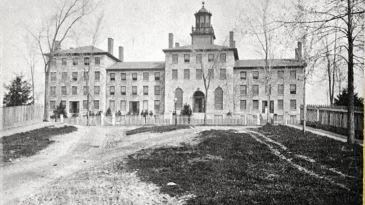

The Theological Task Force on Peace, Unity and Purity revived our interest in Presbyterian history in the United States since 1729, but stopped short of formative roots in the old world. Recently my wife and I joined a presbytery- sponsored tour to visit some sources of our Reformed faith in Scotland and Ireland. We found significant historic challenges to the peace, unity and purity of the church, and also surprising foundations for hope.
"Purity" was a driving force in the turbulent events of the Scottish Reformation. Purity was the match used by John Knox and his colleagues to ignite the flames of church (and national) reform in Scotland--purity in the Word of God, in the sacrament, in the clergy, and in the leaders of the land. In his passion for religious purity, Knox sparked an emotional explosion among Scottish people early in St. Andrews in 1547, and again in Perth, Edinburgh, and beyond beginning in 1559. In these violent birth-years of the Presbyterian Church, purity-minded mobs attacked the churches and monastic houses to strip them bare of their images of "idolatry," typically burning the churches to the ground, and often inflicting bodily harm or death to Catholics who resisted.
Museums and monuments to formative religious struggle marked our Presbyterian heritage across the lowlands and up into the Scottish hills, written in blood by passionate Presbyterians in the never-to-be-forgotten massacres like Glencoe and Culloden.
Being myself a progressive liberal, I turned immediately to the Revised Standard Version of the Bible as soon as it became available in 1946. Hide-bound conservatives in those days called it the Reversed Virgin because the translation of Isaiah 7:14 ("Behold, a young woman shall conceive") differed from the hallowed orthodoxy of the King James Version.
Newsflash!
Aoccdrnig to a rscheearch at an Elingsh uinervtisy, it deosn't mttaer in waht oredr the ltteers in a wrod are, the olny iprmoetnt tihng is taht frist and lsat ltteer is at the rghit pclae. The rset can be a toatl mses and you can sitll raed it wouthit porbelm. Tihs is bcuseae we do not raed ervey lteter by itslef but the wrod as a wlohe. i
Isn't it amazing what powers of perception humans have? Even when mortal expressions are limited and imperfect, humans have been gifted with the ability to discern much more meaning from a written text than a surface review might reveal.
Think how often a word or two -- spoken or written -- is misconstrued because we fail to open our minds to the whole of what is intended by the one desiring to communicate with us.
Some people think the Boxer Rebellion describes the refusal of young males to wear a certain style of undergarment. Actually, it was an event which took place at the beginning of the twentieth century in China. Old movie fans or fans of old movies might enjoy Charleton Heston and Ava Gardner in "55 Days at Peking".
So we know that the Scriptures are inspired by God and are authoritative for the church's faith and life. Does that mean that the words in Scripture uttered by angels are just as inspired as those spoken by God or humans? Do their words carry clout, or can we dismiss them as being platitudes? Getting specific, what's to be made of the angels' song to the shepherds, 'Glory to God in the highest heaven, and on earth peace..." (Luke 2:14a)? If the chief end of humans is to glorify God, then the first line of the angelic song sounds substantive. What about the second line, the one that sings the promise of "peace?"
Granted, modern translators differ as to who should receive the peace promise. Is peace to be experienced by "all people?" Is it intended for "all people of good will?" Or is it being offered only to "those on whom God's favor rests?" What's for sure is that the peace is to be experienced by many, including at least all recipients of God's saving grace. It may be intended, as suggested in other biblical passages, for all persons created by God. Indeed, given the plan for the wolf to lie down with the lamb, it appears that God promises peace for all creation.
What about that peace? Holiday carols sing its melody. Christmas cards echo its refrain. But do we really want it?
Men, I am proud to say, are by nature and nurture gross and disgusting creatures. I did my very best to pass on this crude heritage to our three boys. However, my success was not equal to my desire. I assume their occasional fastidiousness may be traced to their mother's "sugar and spice" influence.
Anointing events as the will of God is a devotional, if not exactly theological, temptation. Christians accept God's providence in both prosperity and adversity, a sentiment famously expressed in the Heidelberg Catechism, which I think represents the irenic and ecumenical Lutheranism of Philip Melanchthon within the burning heart of Calvinism. As a passionate advocate for The Book of Confessions,
Soon after we moved to Pittsburgh I located a Presbyterian physician and went to his office for a medical check up. I filled out a form in the waiting room and was ushered into an examination room and told to take off my clothes. Sitting on the table in my goose bumps, I was just about to get the doctrine of the Trinity figured out when a gorgeous young female nurse opened the door and walked in.
Being one, I like to defend ministers whenever and wherever possible. Our "too too solid flesh" is subject to considerable frailty, but in a Presbyterian pulpit there is little excuse for blatant and pompous stupidity. Listening to a Christmas sermon our family learned a painful lesson in the hermeneutics of suspicion. The text was "Comfort ye, comfort ye my people, says your God" (Isaiah 40:1).
Welcoming Jack Haberer
Editorial note: This issue is the inaugural for Jack Haberer's tenure as editor-in-chief of The Presbyterian Outlook. Several Presbyterian leaders, some of whom have worked with Jack in denominational efforts, give their thoughts on his coming to this new ministry:
Deck the halls with expectation. 'Tis the season for anticipation.
The original lyrics better fit the tune, but these words do fit the season. Children dream sugarplum dreams. Soldiers count down the days to a holiday leave. Shoppers look forward to a smiling friend unwrapping that perfect gift. Worshipers sing of the arrival of the Savior.
Why such December expectations, Advent anticipations?
The answer--God places them in the hearts of believers. They prompted landlocked Noah to build a boat, and elderly Sarai to decorate a nursery. They moved Ruth to leave the green fields of Moab and David to sing songs. They spoke to Mary treasured words of shepherds and angels. They emboldened Peter and John to command, "Rise up and walk."
Sadly, in post-Watergate America and in the post-reunion Presbyterian Church (U.S.A.), cynicism--anticipation's dread enemy--seems to be out-shouting the more hopeful voice. Alongside impatience, apathy, certitude, and self-importance, cynicism has been waging war on the more hopeful Christian virtues of faith and trust. Of course, sinning ways of sinful people continually pump more helium into the balloons of disappointment in the church, but the resulting pessimism misses the point of Christian faith.
Throughout the biblical record and pervasive through church history the refrain is sung, "Have faith in God!" Bold faith animates the stories told of the first century Christians. Deep trust radiates from the lives of millions of faithful through the centuries, and for good reason. God has come through for them. The one who promised to build a church against which the gates of Hades would not prevail has overcome time and again.
In this season of Advent, in a time when many Presbyterians are warning of the demise of the church, how can we recover the vibrant faith of our forebears? Might we dare believe again that the best is yet to come?
Blood everywhere!
So recently The DaVinci Code argues in exciting and so Mel Gibson's "The Passion of the Christ" demonstrates in excruciating detail. In the hot flash of a mini-pause the issue of blood becomes a fascinating subject. The Israelites regarded blood with holy awe because they understood blood to be the life of the flesh. Under the old covenant, the offering of blood was central to the sacrificial system.
This sermon on Luke 4, Jesus' inaugural address in the synagogue at Nazareth, was preached at the Worship and Music Conference in Montreat, North Carolina, in the summer of 2005 by John L. Bell.
I must remember to talk slowly and clearly because you have an accent. Oh, some people don't believe that, but I can testify to that being true, particularly in this place and at this conference to which I first came over 10 years ago.
I was teaching an afternoon elective on a song from the New Testament. It was a setting of the beatitudes in St Luke. It began:
Blessed are the poor,
the kingdom of God is theirs.
I was hardly into the first line when a woman interrupted me and said, "Excuse me, but in our church we talk about -- "and then she said something which sounded like "the pooah in speerit."
So I asked her to repeat herself. And again I heard, "the pooah in speerit."
I was totally puzzled. My mind went to Exodus chapter 1 where there is mention of two Hebrew midwives one of whom is Puah, but the other is Shiphrah not Speerit. As the lady noticed my consternation, she did what my grandfather once advised when dealing with foreigners: speak more loudly. "POOAH IN SPEERIT."
And then the penny dropped, and I realised that the dear lady was saying: "poor in spirit." At first I wondered whether she was denying that our Lord blessed the poor. But then I realised that she was in fact pointing to the alternative versions of the beatitudes. In Luke, Jesus says, "Blessed are the poor," while in Matthew, he says, "Blessed are the poor in spirit."
The stories we are reflecting on today, however, have no alternative. They speak of the raw physical realities with which God is involved: issues of life and death, oppression and liberation which cannot be spiritualised away.
As I listened to John Bell's sermon (link) I thought I was being ushered back into the remembered richness of the Presbyterian/Reformed tradition that nourished my beginnings as a pastor, a tradition that the Outlook has maintained fearlessly over many decades. That emerging tradition was patiently replacing a spurious ecclesiology that supported social injustice. The Outlook was courageous in that enterprise, and was willing, for the gospel and the church's sake, to "be shown the door" if necessary, to speak the truth about church and society.
Ernest Trice Thompson and Aubrey Brown, the first two editors of this paper, in teaching, preaching, and writing, helped to establish in the warp and woof of the church the overturning of the noxious doctrine of the "spirituality of the church" that had become the confessional stance of the PCUS (Southern Church) when we broke away from the national body. As we formed the new denomination in 1861 at Augusta, Ga., we declared that the church's vocation was not to be concerned with the outward condition of human beings, but with their souls only -- which were destined for salvation or damnation. That "faith statement" set the church on a course separating not only charity from justice, but even of separating charity from evangelism. And it was a long, hard road on which to return to the whole gospel for the whole church, and officially to repudiate (in the 1930s) that separation.
Most high school seniors have extensive lists of requirements for potential colleges: location, cost, class sizes, major offerings. While I looked for colleges two years ago, all of those variables were important, but I seemed to have one other prerequisite: a Presbyterian heritage.
When I was asked what I was looking for in a school, I rarely started with the Presbyterian qualifier, but those interested noticed a pattern quickly enough. "Well," I'd say, "I'm looking at (different schools)." And, although each institution has a reputation for academic excellence, the unique common denominator was that of a relationship, whether active or more nominal, with one particular denomination-- my own.
My eagerness to attend a Presbyterian college may seem to have an obvious explanation. As the daughter of a Presbyterian minister (Warrensburg, Mo.), the familiarity of my home denomination's theology and practices seemed comforting as I planned to live on my own for the first time. Plus, occasional scholarship breaks for PKs didn't hurt.
In all honesty, however, there was another, more practical reason for narrowing my search to Presbyterian colleges. It simply made the list of possibilities somewhat more approachable. With hundreds of options, choosing a college seemed an overwhelming prospect, particularly since I was unsure of my career path. By saying "Presby-only," my list seemed reassuring and workable. It also seemed the perfect match for a person who proudly remembers the moment she learned to spell P-R-E-S-B-Y-T-E-R-I-A-N at the age of five.
But then the decision-making moment arrived. And I enrolled in a Baptist school.
Pulpit nominating committees need a lot more help than they are getting. For example, when I left my first pastorate, the pulpit nominating committee met and quickly agreed that whatever else, they did not want another minister who wore a beret and made pastoral calls riding a bicycle. They thought these practices were not only eccentric but weird then, in fact, one was thrifty and the other was theological.
Even though she and her husband lived in a single-room studio apartment during their two years in Ethiopia, our daughter-in-law found it necessary, and quite against her inclination, to employ domestic help. Without the laborsaving devices for cooking, cleaning and washing that American women take for granted, Sara had no other option if she wanted to continue to teach at the seminary in Addis Ababa.
I have read The Presbyterian Outlook since I was a student at Union Theological Seminary, and have continually been grateful for its usefulness. But I must say that when Ben Sparks was announced as its interim editor in February of 2004, the Outlook became much more fun to read.
Ben Sparks first introduced himself to me on the campus of Union Theological Seminary in the fall of 1968 or 1969. I was in my first or second year of seminary; Ben was a member of the Board of Trustees, one of the youngest trustees ever to serve on the board of Union, now Union-PSCE. Ben was living in Roanoke, serving as Urban Minister for Montgomery Presbytery staff. After college, I had spent a year working with an inner city Presbyterian congregation in Brooklyn, New York. Ben wanted to talk with me about that experience. As we visited that afternoon on the Union campus, a friendship based on mutual respect began.
Quickly, I realized that Ben had read more books than I, many more books; he kept up with journals far more than I. A member of the Iona Community in Scotland, Ben treasured participation in that worldwide ecumenical group. Those attributes, along with a keen mind, quick memory, and fun spirit made me eager to let the friendship grow.
On prospective board members my institution desires to make a good impression. This is not easy because the standard campus tour includes classroom time, and I seem to be the only instructor teaching at the hour guests are free to attend a lecture. Over the years these classy people regularly show up at my classy room five minutes before the lecture begins.
It would be easy to name the churches that Ben Sparks has served, list the baptisms, recall the weddings, remember the funerals, appreciate his faithful service to presbyteries and synods, as well as to the church as a whole. Ben is without a doubt hitting his stride.
But that would be the easy part. There is no difficulty in adding the numbers and citing the impressive facts. What is far more important is the distinctive character of the service that he has given to all of these. And there is still more. It is the special quality of life that both he and Annette contribute to all of these activities that make the essential difference.
In some respects it was a natural thing for Ben to become involved with The Presbyterian Outlook. Second Church had not only been the closest neighbor to the Outlook but also its supportive landlord for many years. And as the senior pastor there, Ben had assumed the responsibility of being a special friend and guardian of the publication.
Among the obscure items I collect to amaze my students and annoy my colleagues is the by-now-long-useless fact that in 1869 Alexandrine Tinne was hacked to death by the Touaregs. Alexine was an incredibly rich, incredibly beautiful, incredibly brave woman who, at enormous expense, attempted to explore the White Nile and its tributaries.
Obligatory summer visits to our family requires a road trip from Pittsburgh to Nashville to Albuquerque to Denver to Milwaukee. This duty is rendered pleasant by minor league baseball games all across the country. In my secret heart I still believe if I had not gone to the seminary I might have gone to the baseball hall of fame.
Every body, or to be precise – every mind, needs three reading lists. The first will contain the essential books of your field. The second list will offer solid insights into and felicitous expressions of one's individual and community interests. The third is just plain fun to read.
The scientists in my family have devoted considerable time and effort to educating me in the rudiments of modern physics. For example, "Einstein's Theory of Relativity" is widely mentioned but some of us do not know exactly what to make of it. I rather assumed that Einstein had somehow demonstrated to the satisfaction of the scientific community that everything in the physical world is in relation to everything else in the physical world, which theologians have understood for a long time.
© Copyright 2026 The Presbyterian Outlook. All Rights Reserved. Privacy Statement. Website by Web Publisher PRO