

Last spring, Moderator Rick Ufford-Chase made an extended visit to the Democratic Republic of Congo to visit the churches and peoples of the two Presbyterian partner denominations of the PC(USA). As he traveled, he kept a running journal of his experiences and observations …
Presbyterians need both long-term and short-term mission workers, and I call on Presbyterians to support both. We can afford both, if we renew our commitment and improve our stewardship practices. I also call on Presbyterians to improve what you do in short-term mission, and to update your understandings of what we do together through long-term service.

"The mystery of peace is located in the nature and quality of relationship developed with those most feared."
-- John Paul Lederach
The Moral Imagination
Conversations between Christians with diverse theologies and political circumstance have never been easy. Last year, for example, the Southern Baptist Convention decided to quit the Baptist World Alliance because its theologies were "too liberal" and its criticisms of the United States too many.
A different crisis of ecumenical relations occurred last October in the Presbyterian Church (U.S.A.). With help from its world mission headquarters in Louisville and the participation of its Advisory Committee on Social Witness Policy, it sent a fact-finding delegation to the Middle East. Among other local hosts in visits to six countries were the Middle East Council of Churches and the Synod of Lebanon, Syria. Leaders of the latter asked the delegation to undertake a conversation with representatives of the militant Muslim group Hezbollah. Back in Louisville, denominational executives had advised "caution" about having such a meeting, but they never forbade the delegation to undertake it. The upshot of the event was the firing of two General Assembly staff members for incompetence in permitting that meeting to take place and for failing to protect the church against negative media publicity.
As a longtime student of the ethics of forgiveness and repentance, I have had to ponder the complexity of Jesus' word to disciples that they are to "love your enemies and pray for those who persecute you" (Matthew 5:44). That word applies as much to conflicts inside the church as outside. As a Presbyterian, I am proud of its ecumenical and social justice traditions; and I believe that this internal denominational controversy needs to be judged against the background of twentieth century ecumenical history. Many issues in the incident transcend this one denomination.
Dr. James Smylie’s article in this issue, looking toward the 250th Anniversary of the organization of Hanover Presbytery in 1755, reminds me of one of the losses of the 1983 reunion of the Northern and Southern Presbyterian denominations. “They” took away our name.

“The mystery of peace is located in the nature and quality of relationship developed with those most feared.”
— John Paul Lederach
The Moral Imagination
Conversations between Christians with diverse theologies and political circumstance have never been easy.
Dr. James Smylie’s article in this issue, looking toward the 250th Anniversary of the organization of Hanover Presbytery in 1755, reminds me of one of the losses of the 1983 reunion of the Northern and Southern Presbyterian denominations. “They” took away our name.
With so many others across the church, I am waiting with curiosity and hope for the report of the Theological Task Force..
The goal of the Theological Task Force on Peace, Unity, and Purity of the Church is to "lead the PCUSA in spiritual..
When the Rev. Mark D. Roberts started his blog, he envisioned a small outreach to his community and parishioners at Irvine Presbyterian Church in Irvine, Calif.
A little more than a year later, the blog reaches far beyond that, drawing 1,500 visitors daily -- 2,000 on weekends.
"I have readers literally all over the world," says Roberts, pastor to a 750- member congregation. His review of Mel Gibson's "The Passion of the Christ" has drawn more than 25,000 visitors since the film's release, and it continues to draw readers by the hundreds.
It is but one small example of the growing reach of Christian bloggers going online to evangelize, mobilize and occasionally demonize. They marvel at the way blogs give them an opportunity to engage with a lively and diverse audience they could never attract on their own.
The term "blog" is short for "Web log" and refers to the online journals that have given a public voice to anyone with an Internet connection. Evangelicals, for instance, used blogs to get voters to the polls in November, becoming a big part of President George W. Bush's victory.
I thought about strategies of officer training when confronted by two quite disparate comments this week. Both of them rest upon distinctly "un-Reformed assumptions" about the character and conduct of human life in society -- not only the nation, but also the church. Enshrined in the comments is the inevitable conflict between respecting the right of individual conscience and the upholding the confessions, laws, bill of rights, etc., which, as citizens and disciples, we hold in common and which bind us together. One person, asked on what she based her arguments for intelligent design as scientific principle, said that her "Creator revealed it to me in my heart." The other assertion was quoted from a Supreme Court justice's majority opinion based upon the sovereignty of the individual.

Summer is supposed to be a time when time almost stops ... Tell that to the ministers.
What has the church learned from the explosive response to our actions last summer in Richmond on divestment? Granted this is not everyone's concern, yet by its action -- intentionally or not -- the General Assembly opened the door to widespread public discussion in every place where Jews and Christians have significant contact. We both initiated and contributed to a dialogue that has been sadly lacking in American political life. The General Assembly took heat for these and subsequent actions, one of which resulted in the firing of folk in the Louisville office.
Text: John 16:16-33
One of the best commentaries on the Gospel of John is Dostoyevsky’s The Brothers Karamazov, a novel which also has a good deal to say about theological education. I want to begin by quoting at length a passage from that novel that has to do with a novice priest who has recently graduated from a theological school of sorts and who is struggling to discern the particular shape of God’s call upon his life.
“I can’t imagine anything better for our congregation than to hear from you.” With those words last fall, Rabbi Lucy H.F. Dinner of Raleigh’s Temple Beth Or responded to a letter from Arthur (Art) Ross III, pastor of Raleigh’s White Memorial Church.
Abraham went, and his children followed.
Forty-five “Children of Abraham”— 14 Jews, 15 Christians, 15 Muslims, and one Unitarian-Universalist participated in an interfaith pilgrimage to the Holy Land, February 10-21, 2005, sponsored by the Wilshire Center Interfaith Council of Los Angeles. The pilgrims were led by Rabbi Stephen Julius Stein of the Wilshire Boulevard Temple;
The PC(USA)’s Divestment Policy is a protest of thirty-eight years of Israel’s illegal military occupation in the West Bank, East Jerusalem, and Gaza. The policy is not anti-Israel, anti-Jewish, or anti-Semitic. Its purpose is to promote the end of the occupation.
Presbyterian and Davidson Colleges have been much in the news in the New South states of South and North Carolina respectively. Leslie Scanlon's article delineates the issue at Presbyterian for the OUTLOOK. We covered the controversial proposal one year ago this month (the June 7th issue). That proposal led to the appointment of a commission to study these matters, chaired by Allen McSween of 4th Presbyterian in Greenville, SC. Since religion is big news everywhere, the secular press has given this college conflict extensive coverage.
In the meantime, this past February, Davidson's trustees amended its statement of purpose (see Rob Spach's Oped piece for the Charlotte Observer, which defends the action) to allow (not recruit but allow) 20% of its trustees be of faiths other than Christian, or of no faith. That action has provoked dismay and heated criticism, even though there are by now scores, if not hundreds, of Davidson alumni/ae who are persons of other faiths.
Davidson College’s Board of Trustees recently decided that people who are not active members of a Christian church may serve on that board. Some have criticized this as a move away from our Christian heritage. I would like to offer a different interpretation, as I see the change as a forward-looking expression of how we want our particular understanding of Christian faith to be embodied.
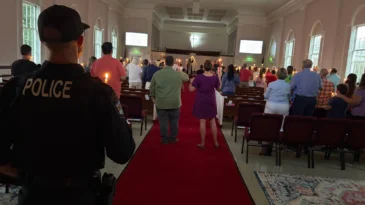
Saturday night, the night before Easter, about 45 of us gathered in the dusk in the narthex outside the sanctuary doors. We settled ourselves and began to gather our hearts for worship - a new service - a kind of modified Easter Vigil for us to try. The sanctuary doors opened to reveal a path of light - tiny votive candles perched on the side of each pew - making a pathway of light through the dim and dark sanctuary.
“Do you not know?” Paul asks the Romans, and then twice firmly announces, “we know,” “we know.” The language hints that something has been misplaced.
We know—unless we have forgotten. We know—unless we assume it didn’t apply in this case or under these particular circumstances. We know—unless we haven’t calculated the fullest consequences of what we have come to know. We know—unless, of course, we don’t know at all.
I am a Presbyterian Jedi. At least that is what some seem to think. Last year I was elected to the Presbyterian Jedi Council (aka General Assembly Council.) I am now “in the know” and the fate of the denomination is in my hands. Depending on whom you ask, I could be either Obi-Wan Kenobi or Darth Vader. Either way, I get the same questions. Membership is declining and there is financial difficulty. What am I going to do to save the denomination?
I've always been suspicious of dividing things in two. Some of my earliest memories are of wanting the whole thing, but being told that my older brother and I had to divide it up. Cake. Candy bars. That last hamburger, sitting on the grill, begging to be eaten. Even Kleenex. Kleenex? Yes, we used them a half tissue at a time. After all, I was raised by the generation that sacrificed through the Great Depression. I would insist on the whole thing. Then I'd hear those dreaded words: "Boys, you're going to have to divide it in two!"
My childhood selfishness aside, church life in the early 21st century is regrettably full of false dichotomies. And at San Francisco Theological Seminary, we are learning to resist and reject false choices that would require us to embrace only one side of a complex reality. Instead, our goal is to put our arms around the whole big mess that is life in the Presbyterian Church (U.S.A.). Liberal or conservative? Yes! We are all both, albeit in different ways and on different subjects. Small church or large church? Yes! God's purposes for service to the world require both, and everything in between. Traditional or contemporary? Yes! Faithfulness requires the best of both. Reformed or ecumenical? Yes! Each requires the other. Theoretical, spiritual, or practical? Yes! Pastoral preparation cannot be comprehensive without all three aspects of formation for ministry, and others as well.
What is your presbytery, session, or congregation doing to prepare for September 15? That day is not on any ecclesiastical calendar. Many congregations are in "start-up" mode after summer vacation. Christian Education and Stewardship dominate the attention of the local church.
However, as far as the PC(USA) is concerned, this is the day the Task Force on Peace, Unity, and Purity will release its report for consideration, discernment, and conversation. This early release date affords the church in sessions, presbyteries, and church school classes ample time for open, free discussion before the 217th General Assembly meeting in June, 2006, in Birmingham, Ala. That assembly will be asked to act on its recommendations.
As the PCUSA Theological Task Force (TTF) on Peace, Unity, and Purity prepares its final report (to be distributed in September), we in the Presbytery of the James have made concerted efforts to be in conversation with each other regarding their work. We formed four theological reflection groups (and are in the process of starting four more), each of which represented a broad theological spectrum.
“I am newly ordained yet already pessimistic about the future of this denomination. I am 30 years old and already tired by the same old arguments and voting trends. I am a Presbyterian who is ashamed that outsiders best know our denomination because of intense bickering rather than our proclamation of the gospel.
© Copyright 2026 The Presbyterian Outlook. All Rights Reserved. Privacy Statement. Website by Web Publisher PRO